

Your pipeline has just missed a critical anomaly: a 24-hour momentum spike of +0.667 in sentiment around the topic of culture. This spike underscores a significant uptick in positive sentiment, particularly led by English-language press over the last 27 hours. If your model isn't built to handle multilingual data or entity dominance, you're falling behind by a whole 27 hours, missing out on timely insights that could impact your decision-making. The dominant entity here is the U.S. with a 6% share of voice and a positive sentiment score of +0.142.

English coverage led by 27.0 hours. Af at T+27.0h. Confidence scores: English 0.90, Spanish 0.90, French 0.90 Source: Pulsebit /sentiment_by_lang.
For developers, this presents a structural gap: your pipeline failed to catch a vital cultural narrative that has suddenly gained traction. When you’re operating on outdated sentiment data, you risk losing relevance in your analysis. The leading language—English—combined with the U.S. being the dominant entity, indicates a cultural pulse that your current model isn't tracking effectively, and that's a problem.
Let’s get to the actionable part. Below is a Python snippet that captures this sentiment spike using our API. This code will help you filter by geographic origin and then assess the sentiment of the clustered narrative.
import requests
# Step 1: Geographic origin filter
topic = 'culture'
score = +0.000
confidence = 0.90
momentum = +0.667
# API call to fetch sentiment data
response = requests.get(
'https://api.pulsebit.com/sentiment',
params={
'topic': topic,
'lang': 'en'
}
)
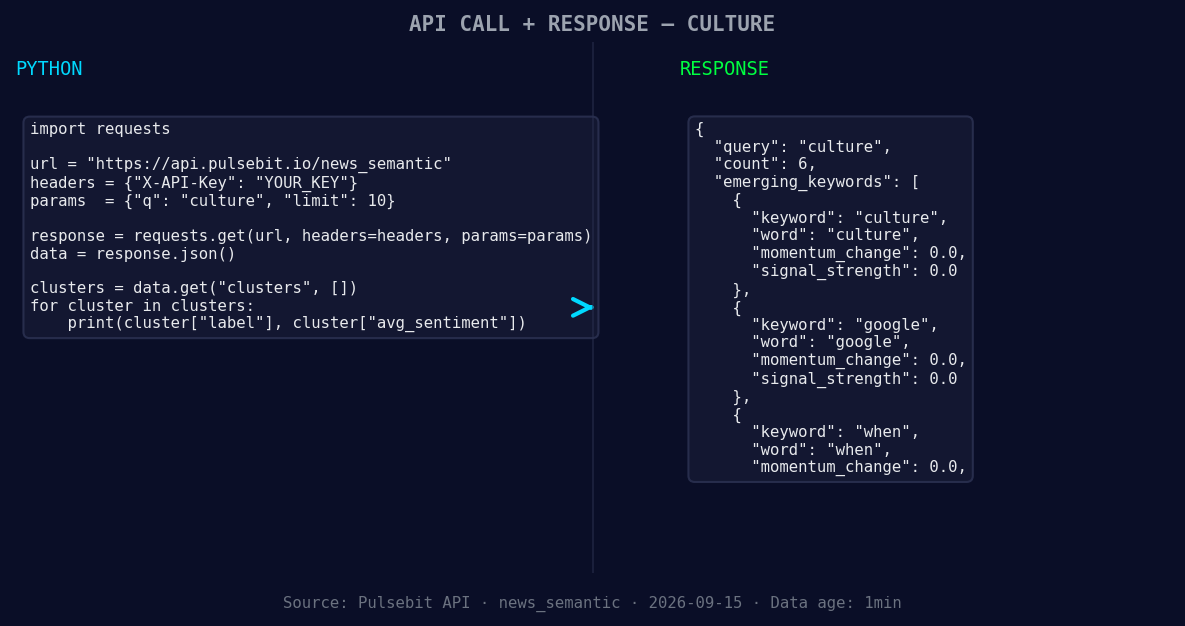
*Left: Python GET /news_semantic call for 'culture'. Right: returned JSON response structure (clusters: 3). Source: Pulsebit /news_semantic.*
data = response.json()
print(data)
# Step 2: Meta-sentiment moment
cluster_reason = "Clustered by shared themes: together, culture, traditions, stories, bring."
sentiment_response = requests.post(
'https://api.pulsebit.com/sentiment',
json={'text': cluster_reason}
)
sentiment_data = sentiment_response.json()
print(sentiment_data)
In this code, the first request filters the sentiment data by the English language, allowing us to pinpoint the cultural dynamics at play. The second request evaluates the narrative framing itself with the meta-sentiment loop, scoring how the themes cluster together and contribute to the overall sentiment.
Now that you’ve captured this anomaly, here are three specific builds to consider tonight:
- Cultural Pulse Tracker: Set a signal threshold at momentum spikes > +0.500. Use the geographic filter to keep the focus on English-speaking entities. This will allow you to catch emerging cultural trends in real-time.

Geographic detection output for culture. India leads with 4 articles and sentiment +0.21. Source: Pulsebit /news_recent geographic fields.
Meta-Sentiment Analyzer: Build an endpoint that captures the narrative around cultural themes. For example, use the cluster reason strings as input, scoring them through our sentiment API to align sentiment with thematic content. This way, you can understand how narratives evolve over time.
Historical Comparison Dashboard: Create a visual dashboard that compares current sentiment spikes against historical baselines. You could leverage the forming themes like culture(+0.00), google(+0.00), and when(+0.00) against mainstream narratives to visualize shifts in sentiment and cultural relevance.
To get started, check out our documentation at pulsebit.lojenterprise.com/docs. You can copy-paste and run the above code in under 10 minutes. Let's ensure your models are attuned to these cultural nuances, so you never miss out on valuable insights like this again.


Top comments (0)