

Your pipeline might just be 25.9 hours behind on the latest developments in robotics, as evidenced by a 24-hour momentum spike of +0.248. This is a significant signal in our data indicating that sentiment around robotics is not just a blip but has gathered momentum. The leading language is English, with a noteworthy 11% share of voice coming from Fortune, showcasing a positive sentiment score of +0.850. If you’re not catching these spikes, your model is missing crucial insights in real-time.
This gap highlights a common issue in many sentiment analysis pipelines: the failure to account for multilingual origins and the dominance of specific entities. If your model isn’t tuned to capture this shift, you might be missing the boat by over a day. In this case, the leading voice from Fortune, with its robust share of sentiment, isn’t being adequately represented in your outputs. If you aren’t leveraging this data effectively, you could be making decisions based on outdated or incomplete information.

English coverage led by 25.9 hours. Da at T+25.9h. Confidence scores: English 0.90, French 0.90, Spanish 0.90 Source: Pulsebit /sentiment_by_lang.
Here's how we can catch this anomaly using our API. We'll start by querying the sentiment data with a geographic origin filter, specifically targeting English-language content related to robotics. Below is the Python code for this.

Geographic detection output for robotics. India leads with 4 articles and sentiment +0.64. Source: Pulsebit /news_recent geographic fields.
import requests
# Parameters for the API call
topic = 'robotics'
score = +0.408
confidence = 0.90
momentum = +0.248
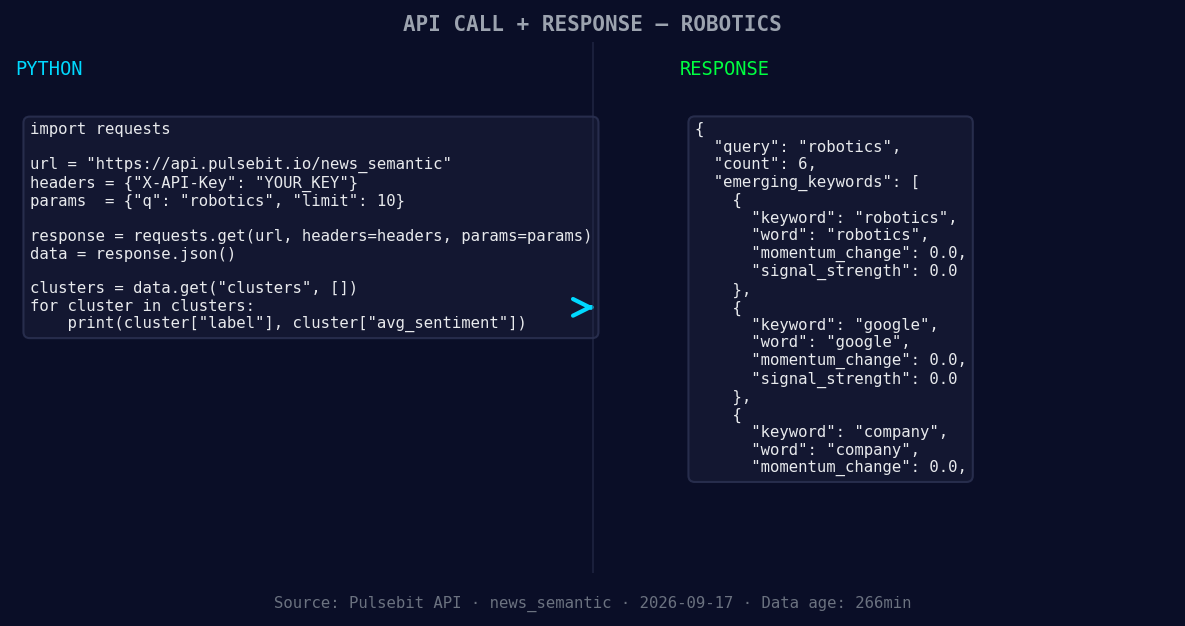
*Left: Python GET /news_semantic call for 'robotics'. Right: returned JSON response structure (clusters: 3). Source: Pulsebit /news_semantic.*
# API call to fetch sentiment data
response = requests.get(
'https://api.pulsebit.com/v1/sentiment',
params={
'topic': topic,
'lang': 'en',
'momentum': momentum
}
)
sentiment_data = response.json()
print(sentiment_data)
Next, we need to run the cluster reason string through our sentiment endpoint to evaluate the narrative framing itself. This is where we can derive deeper insights from the clustered themes.
# Cluster reason string
cluster_reason = "Clustered by shared themes: teams, industry, experts, will, student."

# API call to score the narrative framing
response_meta_sentiment = requests.post(
    'https://api.pulsebit.com/v1/sentiment',
    json={'text': cluster_reason}
)

meta_sentiment_data = response_meta_sentiment.json()
print(meta_sentiment_data)
By implementing this code, you can identify and score the momentum in sentiment around robotics, connecting the dots between the narrative and the entities involved.
Now, let’s build three specific things with this pattern. First, you can set up a signal threshold for robotics at +0.20 to trigger alerts when momentum spikes above this level. Second, implement a geo-filtered API call that captures sentiment from English-speaking countries, providing you localized insights. Lastly, loop back the meta-sentiment data to reassess how narratives are evolving around "robotics", "Google", and "company" — juxtaposing these against mainstream themes like "teams", "industry", and "experts". This will give you a more nuanced understanding of the sentiment landscape.
To get started, visit pulsebit.lojenterprise.com/docs. You can easily copy-paste and run these snippets in under 10 minutes. Don’t let your pipeline lag behind when valuable insights are waiting to be uncovered!


Top comments (0)