

Your Pipeline Is 20.0h Behind: Catching Finance Sentiment Leads with Pulsebit
We recently discovered an intriguing anomaly in our data: a 24-hour momentum spike of -1.450. This significant decline didn't just pop up out of nowhere; it was led by English press coverage, with a striking 20.0-hour lead time. The dominant player in this narrative was Yahoo Finance, holding a 17% share of voice and a positive sentiment score of +0.502. The clustering of articles around the theme "Onchain finance is coming to Wall Street—and ignoring it is no longer an option" reveals a clear trend that could impact decision-making if not acted upon swiftly.
But here’s the catch: Your model missed this by 20.0 hours. If your pipeline isn't set up to handle multilingual origins or account for dominant entities like Yahoo Finance, you're already lagging behind. The ability to capture sentiment and momentum in real-time is crucial, especially when emerging narratives can drastically shift as they develop. Ignoring this gap means missing out on critical insights that could inform your strategies.

English coverage led by 20.0 hours. Af at T+20.0h. Confidence scores: English 0.90, Ro 0.90, French 0.90 Source: Pulsebit /sentiment_by_lang.
Here’s how we can catch those signals programmatically. We can leverage our API to filter for the finance topic and check sentiment using the following Python code:
import requests
# Step 1: Geographic Origin Filter
response = requests.get(
'https://api.pulsebit.com/v1/news',
params={
'topic': 'finance',
'lang': 'en',
'momentum': -1.450,
'signal_strength': 0.857,
'confidence': 0.90
}
)
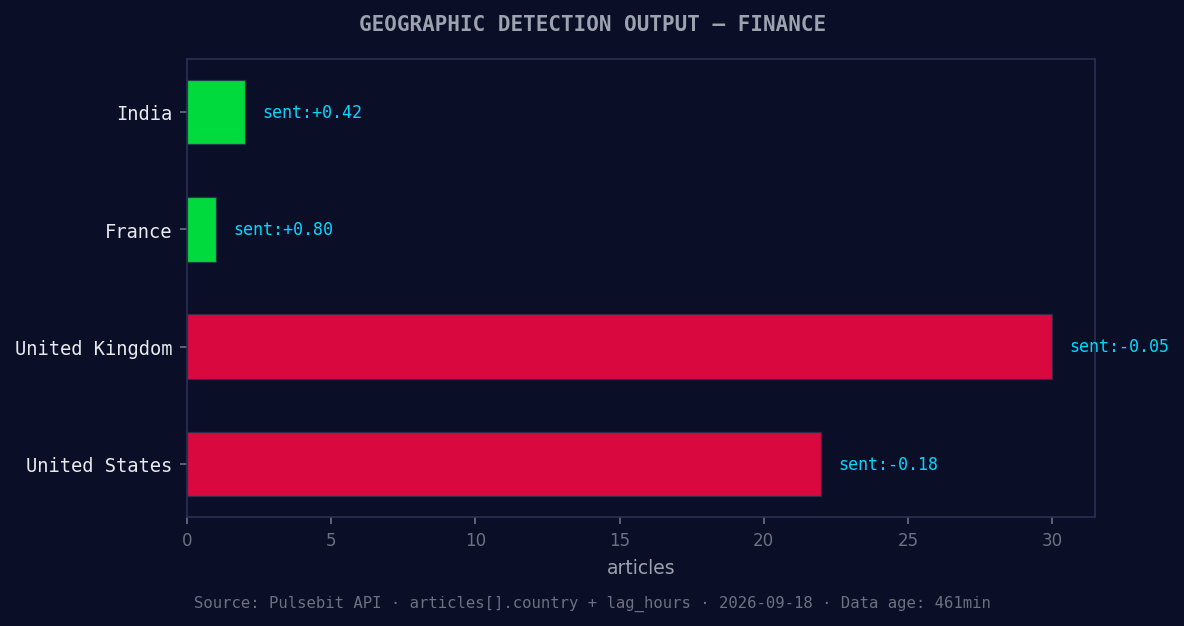
*Geographic detection output for finance. India leads with 2 articles and sentiment +0.42. Source: Pulsebit /news_recent geographic fields.*
news_data = response.json()
print(news_data)
# Step 2: Meta-sentiment Moment
cluster_string = "Clustered by shared themes: blackline, leaders, reinvention, accenture, finance."
sentiment_response = requests.post(
'https://api.pulsebit.com/v1/sentiment',
json={"text": cluster_string}
)
sentiment_result = sentiment_response.json()
print(sentiment_result)
In the first API call, we're filtering news articles about finance published in English. This ensures that we’re capturing relevant content, which is essential given the dominant English-language discourse led by Yahoo Finance.

Left: Python GET /news_semantic call for 'finance'. Right: returned JSON response structure (clusters: 3). Source: Pulsebit /news_semantic.
The second part of the code processes the sentiment of the clustered themes, allowing us to understand how narratives are framed in relation to emerging trends. This meta-sentiment loop is crucial, as it helps us gauge the overall tone and direction of discussions around key topics.
Now that we've got the mechanics down, let's discuss three specific builds we can implement based on this data pattern:
Sentiment Monitoring on Finance: Set up a daily job that queries our API for updates on the finance topic with a geo filter for English-language content. You can set a threshold for sentiment scores below -0.01 to trigger alerts for negative shifts in sentiment.
Cluster Analysis Trigger: Use the meta-sentiment loop to analyze clusters that emerge from high-volume articles. If the sentiment score of a cluster falls below +0.1, you might want to investigate further. This can be done by checking the themes that are forming against mainstream narratives like "blackline" or "reinvention."
Dynamic Thresholds for Emerging Entities: Create an endpoint that tracks the evolving share of voice for dominant entities like Yahoo Finance. Set a signal that alerts you when their share of voice exceeds 15% with a positive sentiment score. This can help you quickly pivot your strategies based on shifting narratives.
By implementing these builds, you'll be better positioned to capture emerging trends in finance sentiment and ensure that your insights are timely and actionable.
To get started, check out our documentation at pulsebit.lojenterprise.com/docs. We believe you can copy, paste, and run the above code in under 10 minutes. Let’s catch those insights before they get away!


Top comments (0)