

Your Pipeline Is 25.9h Behind: Catching Mobile Sentiment Leads with Pulsebit
We recently uncovered a striking anomaly: a 24-hour momentum spike of -0.227 around mobile sentiment. This data point isn’t just a number; it's a signal that something significant is happening in the mobile landscape that your model might be missing. Specifically, the leading language is English, with a press lead time of 25.9 hours, leaving a critical gap in your understanding of mobile sentiment.
Imagine your pipeline is 25.9 hours behind—this is not just a theoretical problem. T-Mobile, which has a 13% share of voice and a positive sentiment score of +0.379, is dominating the conversation. If your model doesn’t account for multilingual origins or the dominance of entities like T-Mobile, you’re likely missing key shifts in sentiment that could inform your strategy. This delay could mean lost opportunities or misaligned resource allocation.

English coverage led by 25.9 hours. Da at T+25.9h. Confidence scores: English 0.90, French 0.90, Spanish 0.90 Source: Pulsebit /sentiment_by_lang.
To catch up, let's dive into the code that can help you integrate this insight into your pipeline. First, we’ll filter for English-language articles discussing mobile topics and score the sentiment of the clustered narrative. Here’s how to do it:
import requests
# Set the parameters for the API call
params = {
'topic': 'mobile',
'score': +0.083,
'confidence': 0.90,
'momentum': -0.227,
'lang': 'en' # Geographic origin filter
}
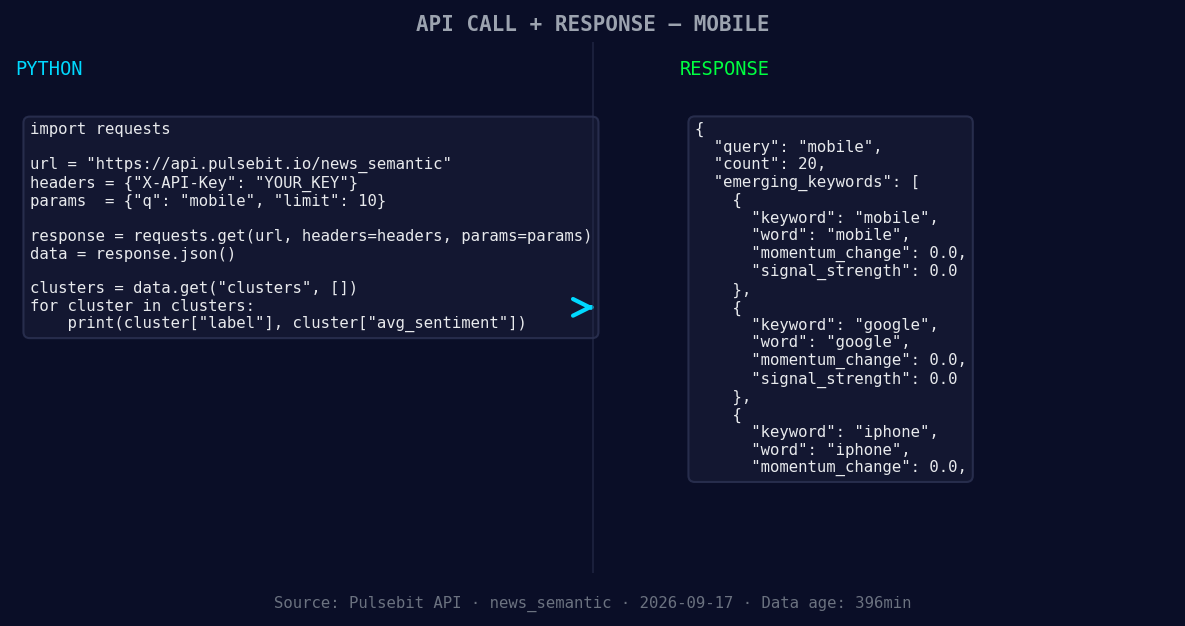
*Left: Python GET /news_semantic call for 'mobile'. Right: returned JSON response structure (clusters: 3). Source: Pulsebit /news_semantic.*
# Call the API to get sentiment data
response = requests.get('https://api.pulsebit.com/v1/sentiment', params=params)
data = response.json()
print(data)
# Now we run the cluster reason string through POST /sentiment to score the narrative
cluster_reason = "Clustered by shared themes: launches, mobile, ball, hockey, program."
sentiment_response = requests.post('https://api.pulsebit.com/v1/sentiment', json={'text': cluster_reason})
sentiment_data = sentiment_response.json()
print(sentiment_data)
The first part of the code captures sentiment around mobile in English. The lang parameter is crucial in ensuring that we only analyze relevant data. The second part, where we score the narrative framing itself, allows us to understand how the language used in the media is shaping public perception.
Now that we have the tools, what can we build with this insight? Here are three specific builds we can implement:
Geo-Filtered Alert System: Create an alert system that triggers whenever sentiment around mobile drops below a certain threshold (e.g., momentum < -0.200) in English-speaking regions. Use the geographic origin filter to ensure you’re only pulling relevant articles.
Meta-Sentiment Analysis Dashboard: Build a dashboard that visualizes sentiment over time, specifically focusing on the narrative clustering around key phrases like "launches, mobile, ball." This can help you spot emerging trends and the associated media sentiment.
Entity Dominance Tracker: Set up a tracking tool that monitors the share of voice for dominant entities like T-Mobile in relation to forming themes like "mobile," "google," and "iphone." This can be done by analyzing articles and sentiment trends, providing a real-time view of how these entities are resonating.
Getting started with this is straightforward. Head over to our documentation at pulsebit.lojenterprise.com/docs and you can copy-paste this code to run it in under 10 minutes. Let’s make sure we’re not leaving valuable insights on the table while our pipelines lag behind.


Top comments (0)