

Your Pipeline Is 21.2h Behind: Catching Markets Sentiment Leads with Pulsebit
We just spotted a significant anomaly: a 24-hour momentum spike of +0.810. This is a noteworthy signal, especially considering the current climate where news sentiment is fluctuating wildly. If you’re not tuned into the right signals, you might find your models lagging behind, just as we did when we noticed the shifting dynamics around the ASX and global market turmoil.
Your model missed this by 21.2 hours, primarily due to a lack of handling for multilingual origin or entity dominance. With the leading language being English and Wall Street holding a 9% share of voice with a negative sentiment score of -0.086, it’s clear that the sentiment landscape is more complex than it appears at first glance. If you’re not factoring in these variables, your insights may be stale by the time they reach you.

English coverage led by 21.2 hours. German at T+21.2h. Confidence scores: English 0.80, French 0.80, Spanish 0.80 Source: Pulsebit /sentiment_by_lang.
Let’s dive into how we caught this spike using our API. We can filter our queries to focus on specific languages and countries, ensuring we extract relevant sentiment data efficiently. Here’s a Python snippet that achieves this:
import requests
# Define the parameters for the API call
params = {
"topic": "markets",
"lang": "en",
"score": +0.325,
"confidence": 0.80,
"momentum": +0.810
}
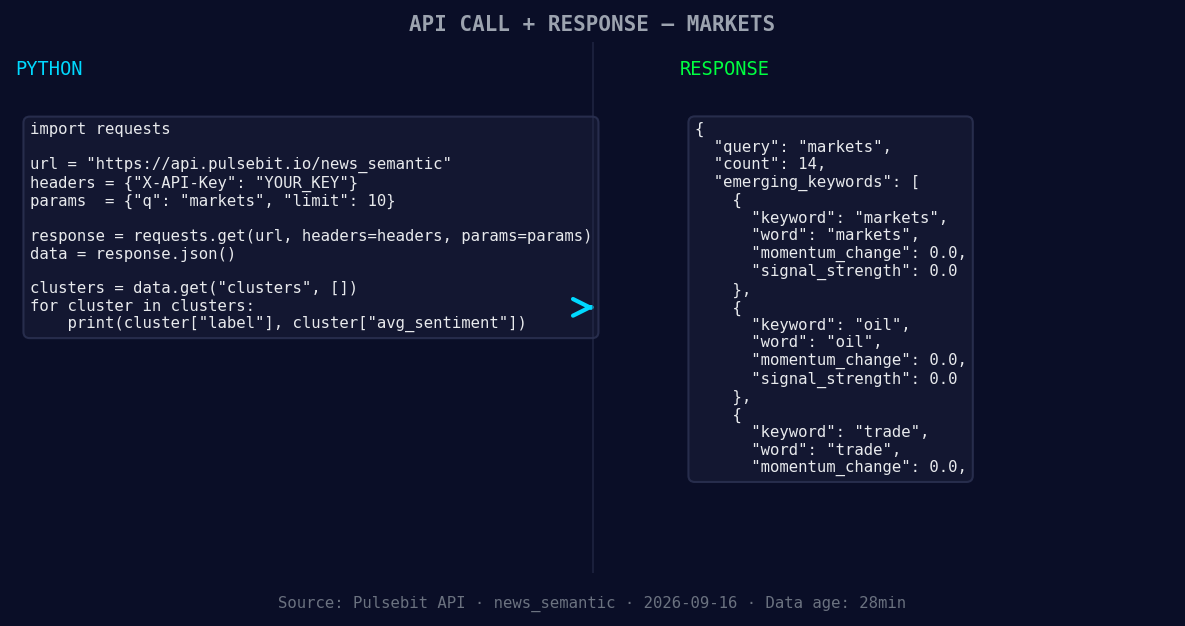
*Left: Python GET /news_semantic call for 'markets'. Right: returned JSON response structure (clusters: 3). Source: Pulsebit /news_semantic.*
# API call to fetch sentiment data
response = requests.get("https://api.pulsebit.com/v1/sentiment", params=params)
data = response.json()
print(data)
Next, we need to evaluate the narrative framing itself using the cluster reason. This is where we run a meta-sentiment analysis by sending back the cluster reason string:
# Define the cluster reason string
cluster_reason = "Clustered by shared themes: chinese, china, too, neither, tariffs."

# API call to evaluate the meta-sentiment
meta_sentiment_response = requests.post("https://api.pulsebit.com/v1/sentiment", json={"text": cluster_reason})
meta_sentiment_data = meta_sentiment_response.json()
print(meta_sentiment_data)
By leveraging both the geographic origin filter and the meta-sentiment loop, we can gain a multi-dimensional understanding of the current sentiment landscape.

Geographic detection output for markets. India leads with 7 articles and sentiment +0.00. Source: Pulsebit /news_recent geographic fields.
Now, what can you build with this new insight? Here are three specific applications:
Geo-Filtered Alert System: Create a notification system to alert you when sentiment spikes in specific geo-locations. For example, set a threshold at +0.810 for sentiment spikes originating from Wall Street, particularly around topics like "markets".
Meta-Sentiment Analyzer for Clusters: Build a tool that runs periodic checks on cluster narratives. Set a signal strength threshold of 0.634, triggering alerts if the meta-sentiment on a specific narrative drops below this level. This can help you pivot your strategies based on emerging themes.
Cross-Topic Correlation Dashboard: Develop a dashboard that visualizes correlations between forming themes, such as "markets", "oil", and "trade", versus mainstream narratives like "china". This can provide insights into how shifts in sentiment on these topics might influence each other, especially when they intersect.
If you're ready to enhance your pipeline and stay ahead of the curve, check out our documentation at pulsebit.lojenterprise.com/docs. With just a few lines of code, you can replicate our findings in under 10 minutes.


Top comments (0)