

Your model just missed a critical anomaly: a 24h momentum spike of +0.653. This significant uptick in sentiment is primarily driven by English press coverage, leading by 8.3 hours with a positive sentiment score of +0.433. The dominant entity here is China, holding a 7% share of voice in this narrative. The clustered story that ties this all together is "VIT vice-president receives Crown Jewel of World Tamils Award in Mauritius," which highlights the intersection of cultural recognition and geopolitics. If you’re not leveraging multilingual data and entity dominance, you’re risking being out of sync with emerging trends.

English coverage led by 8.3 hours. Da at T+8.3h. Confidence scores: English 0.80, French 0.80, Spanish 0.80 Source: Pulsebit /sentiment_by_lang.
This anomaly reveals a structural gap in your pipeline if it doesn’t handle multilingual origins or entity dominance effectively. Your model missed this by 8.3 hours, leaving you behind in capturing the sentiment around a significant geopolitical event. The leading language in this spike is English, but the narrative is heavily influenced by Chinese perspectives. When your system lacks the capability to process and prioritize data across languages and entities, you risk missing out on critical insights that could inform your strategies.
To catch this momentum spike, we can leverage our API. Here’s how you can do it with Python:
import requests
# Define parameters
topic = 'world'
score = +0.097
confidence = 0.80
momentum = +0.653
lang = 'en'
# API call to get sentiment data
response = requests.get(f'https://api.pulsebit.com/sentiment?topic={topic}&lang={lang}')
data = response.json()
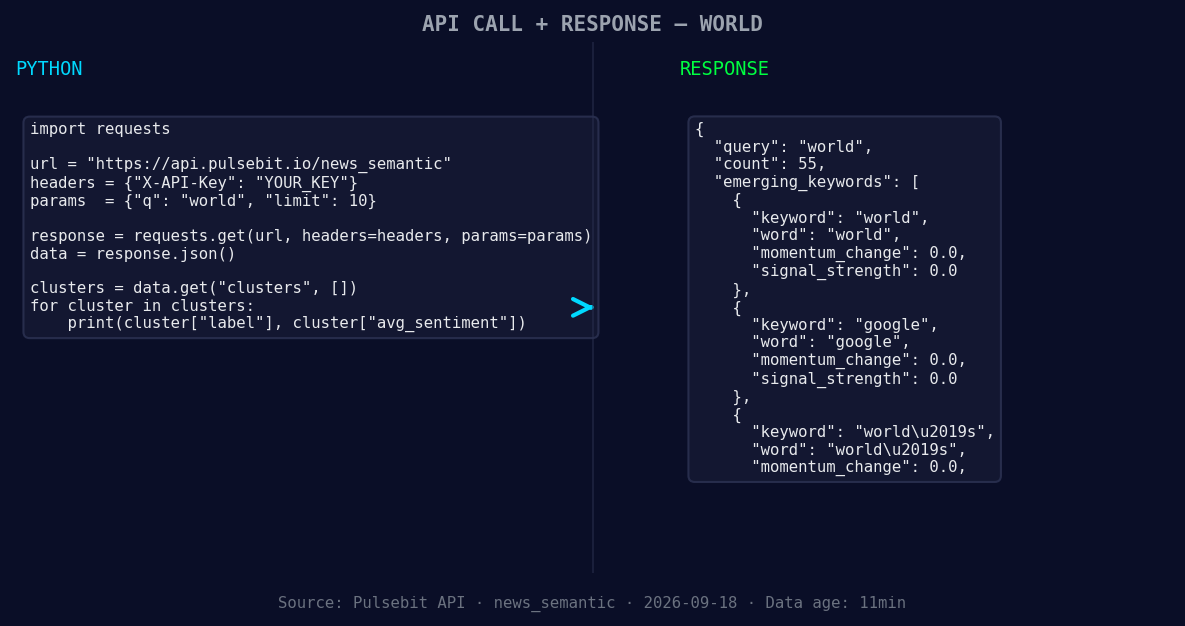
*Left: Python GET /news_semantic call for 'world'. Right: returned JSON response structure (clusters: 3). Source: Pulsebit /news_semantic.*
# Check if response is valid
if response.status_code == 200:
print("Sentiment data retrieved successfully.")
else:
print("Error retrieving data:", data)
# Meta-sentiment loop
cluster_reason = "Clustered by shared themes: vit, vice-president, crown, jewel, world."
sentiment_response = requests.post('https://api.pulsebit.com/sentiment', json={'text': cluster_reason})
meta_sentiment_data = sentiment_response.json()
if sentiment_response.status_code == 200:
print("Meta-sentiment score:", meta_sentiment_data['score'])
else:
print("Error retrieving meta-sentiment data:", meta_sentiment_data)
This script first queries our API for sentiment data related to the topic “world,” specifically filtering for English. It then passes the cluster reason back through our sentiment analysis endpoint to evaluate the framing of the narrative itself. By doing this, you gain insight not only into the sentiment direction but also into how the narrative is structured, which can be crucial for understanding the underlying themes.
Now, let’s talk about three specific builds you can implement with this pattern:
- Geographic Origin Filter: Create a signal that alerts you when sentiment spikes occur in specific regions. For instance, if you detect a momentum score exceeding +0.653 with a share of voice over 5% in English from China, trigger an alert for further investigation.

Geographic detection output for world. India leads with 43 articles and sentiment +0.38. Source: Pulsebit /news_recent geographic fields.
Meta-Sentiment Loop: Build a function that continuously monitors clustered narratives. If the meta-sentiment score from the cluster reason exceeds a threshold of +0.1, log it for potential follow-up articles or research.
Forming Themes Tracker: Set up a monitoring system for forming themes like “world(+0.00)” and “google(+0.00)” against mainstream narratives like “vit, vice-president, crown.” If the delta between these themes hits a certain threshold, say +0.2, it could indicate emerging trends worth exploring.
By utilizing these builds, you can stay ahead of the curve and ensure your insights are timely and relevant.
If you want to dive deeper, check out our documentation at pulsebit.lojenterprise.com/docs. You can copy-paste and run this in under 10 minutes to see the results for yourself. Happy coding!


Top comments (0)