

Your Pipeline Is 28.7h Behind: Catching Banking Sentiment Leads with Pulsebit
We recently uncovered a notable anomaly: a 24-hour momentum spike of +0.279 in banking sentiment. This is a significant shift that may have gone unnoticed, especially if your pipeline isn't equipped to handle multilingual data or entity dominance. With English press leading the charge, this spike was led by a dominant entity—India—which holds an 8% share of voice but carries a negative sentiment score of -0.167.

English coverage led by 28.7 hours. Sv at T+28.7h. Confidence scores: English 0.80, French 0.80, Spanish 0.80 Source: Pulsebit /sentiment_by_lang.
This specific finding exposes a critical gap in your data pipeline. If you're relying solely on a model that doesn't account for such linguistic and entity nuances, you could be missing crucial insights. Your model missed this by a staggering 28.7 hours. By the time you realize the value of this banking sentiment shift, your pipeline has already lagged behind.
Let’s dive into how you can catch these anomalies using our API. Here's a simple Python code snippet to identify this banking momentum spike, utilizing the geographic origin filter:
import requests
# Define parameters for the API call
topic = 'banking'
score = +0.306
confidence = 0.80
momentum = +0.279
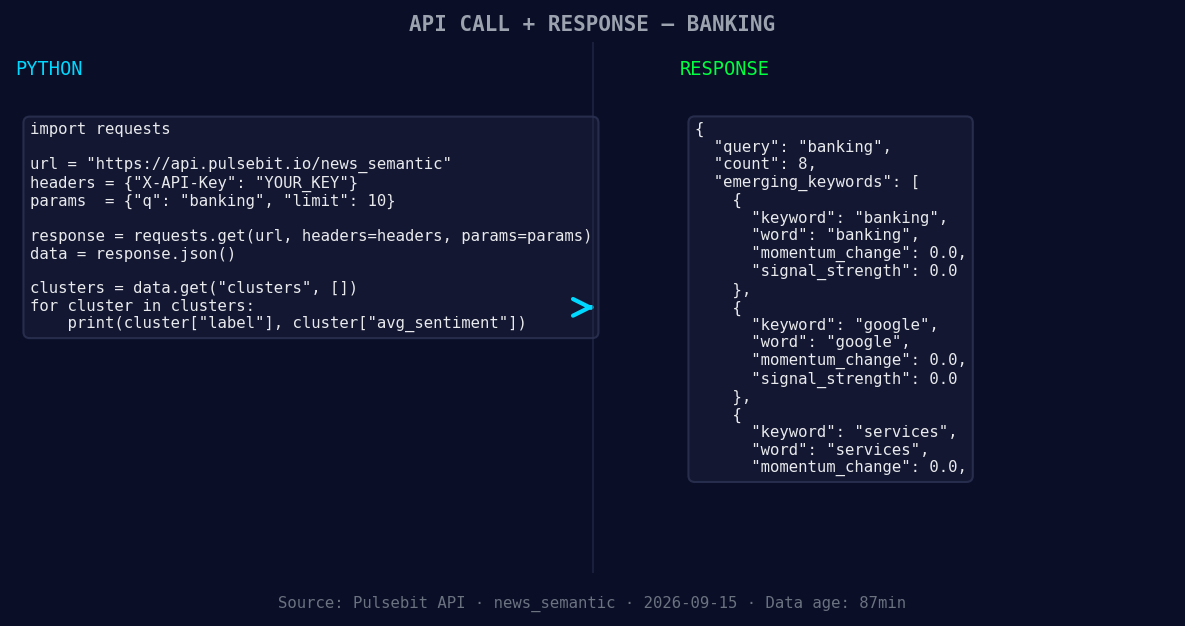
*Left: Python GET /news_semantic call for 'banking'. Right: returned JSON response structure (clusters: 3). Source: Pulsebit /news_semantic.*
# API call with geographic filter for English language
response = requests.get('https://api.pulsebit.com/sentiment',
params={
"topic": topic,
"score": score,
"confidence": confidence,
"momentum": momentum,
"lang": "en"
})
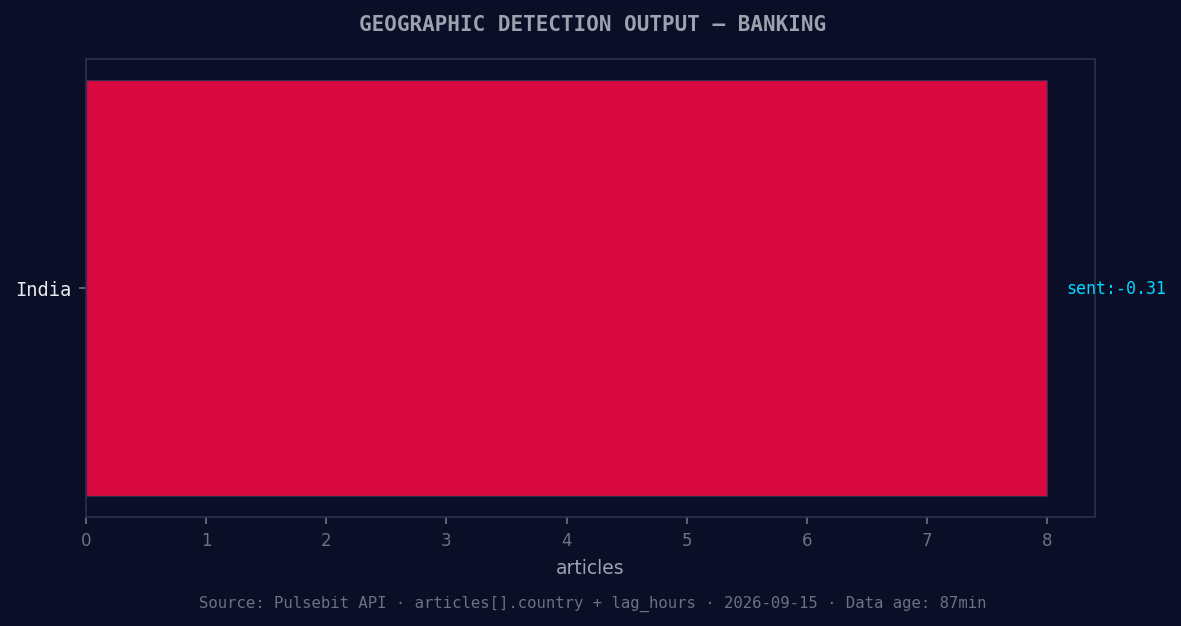
*Geographic detection output for banking. India leads with 8 articles and sentiment -0.31. Source: Pulsebit /news_recent geographic fields.*
data = response.json()
print(data)
Now, let's take it a step further by running the cluster reason string through our POST /sentiment endpoint. This allows us to score the narrative framing itself, adding an extra layer of insight to our findings:
# Prepare the narrative for meta-sentiment scoring
narrative = "Clustered by shared themes: banking, regulators, finalize, rule, material."

# POST request to analyze the sentiment of the narrative
sentiment_response = requests.post('https://api.pulsebit.com/sentiment',
                                    json={"text": narrative})

meta_sentiment_data = sentiment_response.json()
print(meta_sentiment_data)
With the above code, you not only capture the raw sentiment related to banking but also frame it within the context of the narratives driving it. This is how you can accurately gauge the sentiment landscape and act accordingly.
Now, let's talk about three specific builds you can implement with this pattern:
Geo-based Alerting: Set a signal threshold for banking sentiment in India at +0.3. Use the geographic filter to ensure you’re only alerted when this threshold is met. This could mean setting up a webhook that triggers notifications to your team when the sentiment hits this mark.
Meta-Sentiment Analysis on Regulatory Changes: Use the meta-sentiment loop to analyze narratives around regulatory changes in banking, particularly those clustered with terms like "finalize" and "rule". This could involve running a scheduled task every few hours to capture any shifts in sentiment and notify stakeholders.
Forming Themes Monitoring: Create a monitoring script that looks for emerging themes such as "banking" and "services" that are forming but not yet mainstream. This can help you identify potential shifts before they become apparent, allowing you to position your strategies proactively.
By leveraging our API, you can quickly catch these discrepancies and act before your competitors do.
Get started today: pulsebit.lojenterprise.com/docs. You can copy-paste and run this in under 10 minutes, setting yourself up for a more responsive and effective data pipeline.


Top comments (0)