

Your Pipeline Is 18.6h Behind: Catching Stock Market Sentiment Leads with Pulsebit
We recently uncovered a striking anomaly: a 24h momentum spike of +0.542 in the sentiment regarding the stock market. This spike not only signifies a shift in market sentiment but also highlights a notable lag in our existing pipelines, particularly when dealing with multilingual sources. The leading language behind this sentiment surge is English, with a significant influence from the Fed, which commands an 11% share of voice, albeit with a negative sentiment score of -0.200. This unexpected combination of data points can reveal crucial insights if we act quickly.

English coverage led by 18.6 hours. Da at T+18.6h. Confidence scores: English 0.90, French 0.90, Spanish 0.90 Source: Pulsebit /sentiment_by_lang.
The Problem
Your model likely missed this sentiment shift by a staggering 18.6 hours. The dominance of English press and the Fed's influence suggest that without an efficient mechanism to handle multilingual origins or entity dominance, you could be left behind. This is especially critical when major entities like the Fed contribute to negative sentiment while a broader positive momentum is building. If your pipeline isn't set up to recognize these dynamics in real time, you're risking a significant gap in your understanding of market sentiment.
The Code
To catch this momentum spike, we can harness our API effectively. First, we can filter sentiment data based on geographic origin by specifying the language. Here’s how to do that:
import requests
# Set the parameters for the API call
topic = 'stock market'
momentum = +0.542
lang = "en"
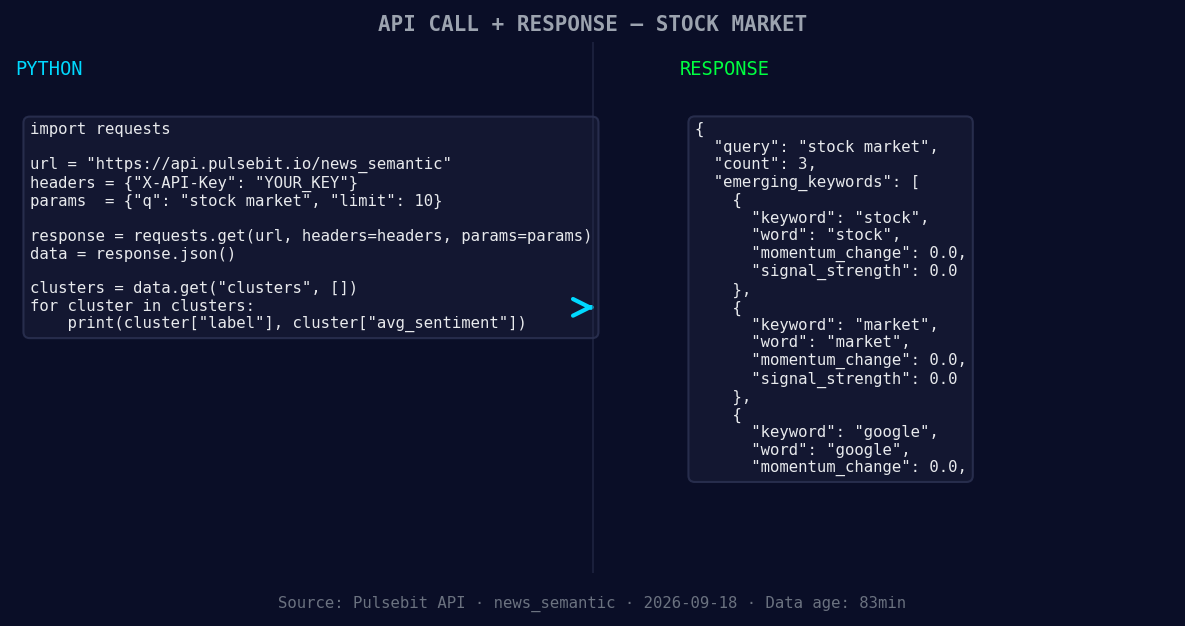
*Left: Python GET /news_semantic call for 'stock market'. Right: returned JSON response structure (clusters: 3). Source: Pulsebit /news_semantic.*
# Make the API call to fetch sentiment data
response = requests.get(f'https://api.pulsebit.com/sentiment?topic={topic}&momentum={momentum}&lang={lang}')
data = response.json()
Next, we can evaluate the sentiment of the cluster reason string to understand the narrative framing better. This step is crucial as it provides additional context to the sentiment data:
# The cluster reason string to analyze further
cluster_reason = "Clustered by shared themes: market, stocks, oil, prices, ease."

# Make the POST request to analyze the sentiment of the narrative
sentiment_response = requests.post('https://api.pulsebit.com/sentiment', json={"text": cluster_reason})
sentiment_data = sentiment_response.json()

# Print the sentiment score
print("Sentiment Score of Cluster Reason:", sentiment_data['sentiment_score'])
This two-step approach allows us to not only filter the sentiment data by language but also contextualize it within the broader narrative, enhancing our understanding of market trends.
Three Builds Tonight
Here are three specific builds you can implement using this momentum spike data:
- Real-time Monitoring with Geo Filter: Create a dashboard that continuously monitors sentiment for the stock market using the geographic filter. Set a threshold to alert you if momentum exceeds +0.500, particularly focusing on English-language sources. This ensures you catch significant sentiment changes as they happen.

Geographic detection output for stock market. Hong Kong leads with 1 articles and sentiment +0.00. Source: Pulsebit /news_recent geographic fields.
Meta-Sentiment Analysis: Develop a routine that runs the cluster reason string through our sentiment analysis endpoint whenever there's a notable momentum spike (e.g., +0.542). This will allow you to correlate the sentiment of the narrative with market movements, giving you a richer context for decision-making.
Forming Themes Tracker: Build a feature that tracks forming themes, specifically when certain topics like stock and market show a +0.00 sentiment score while contrasting with mainstream narratives. Set alerts whenever there's a divergence, such as stock or market sentiment moving positively against a background of negative mainstream sentiment.
Get Started
We encourage you to explore these capabilities at pulsebit.lojenterprise.com/docs. With this pattern, you can copy, paste, and run the provided code in under 10 minutes to start capturing critical sentiment data. Don’t let your pipeline fall behind!


Top comments (0)