

Your Pipeline Is 4.3h Behind: Catching Health Sentiment Leads with Pulsebit
In the last 24 hours, we observed a momentum spike of -1.100 in the health sentiment space. This anomaly was driven by a cluster of articles including "The Hindu Group celebrates 148th anniversary with ‘Health & Wellness’ talk." The leading language was English, with a significant share of voice stemming from the U.S. at 5%. Despite the positive sentiment score of +0.185, the health topic is experiencing a notable downturn, which begs the question: Are we catching these early signals in our sentiment analysis pipelines?
The gap here is glaring. If your pipeline isn't set up to handle multilingual origins or the dominance of specific entities, you could be missing critical insights by over 4 hours. In this case, the leading language being English and the dominant entity being the U.S. means that any model not tuned to recognize these factors would likely overlook significant sentiment shifts. You could easily be caught off-guard while a key narrative unfolds.

English coverage led by 4.3 hours. Da at T+4.3h. Confidence scores: English 0.90, French 0.90, Spanish 0.90 Source: Pulsebit /sentiment_by_lang.
To ensure we capitalize on these momentum shifts, let’s dive into the code that can catch these signals. We’ll start by filtering through our data using the geographic origin combined with the leading language:

Geographic detection output for health. India leads with 8 articles and sentiment +0.78. Source: Pulsebit /news_recent geographic fields.
import requests
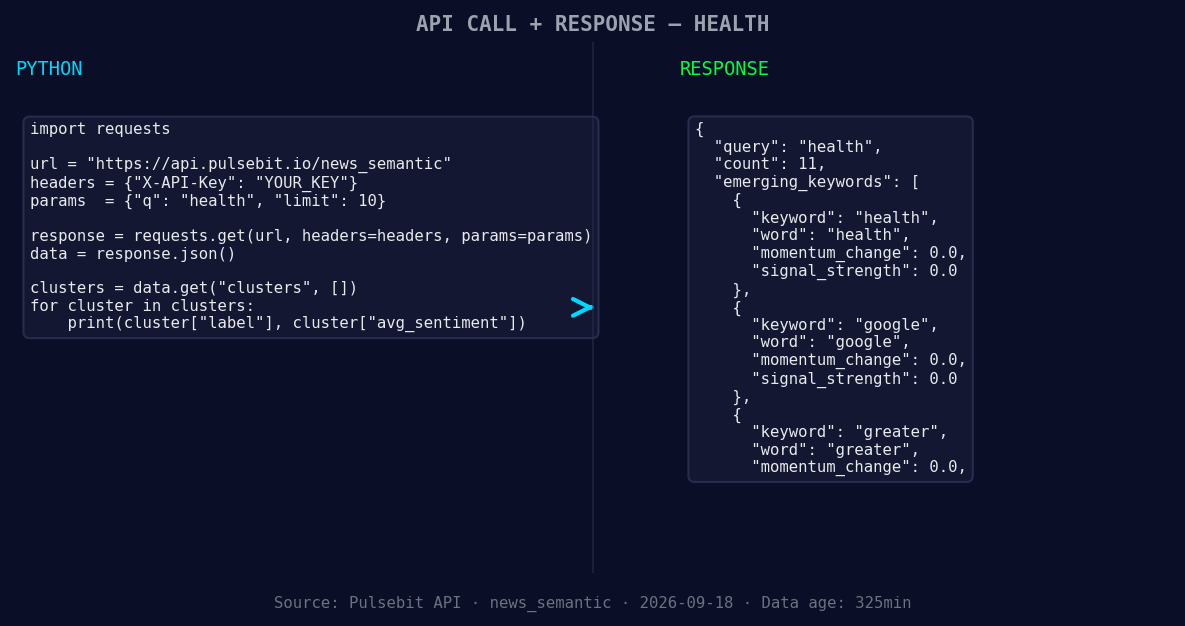
*Left: Python GET /news_semantic call for 'health'. Right: returned JSON response structure (clusters: 3). Source: Pulsebit /news_semantic.*
url = "https://api.pulsebit.com/v1/sentiment"
params = {
"topic": "health",
"score": +0.525,
"confidence": 0.90,
"momentum": -1.100,
"lang": "en"
}
response = requests.get(url, params=params)
data = response.json()
print(data)
With the above code, we are querying our API to filter sentiment related to health, ensuring we only capture English language content. Now, let's take a closer look at the narrative framing. We’ll run our cluster's reason string through our sentiment endpoint to get a deeper understanding of how the narrative is being shaped:
narrative_string = "Clustered by shared themes: hindu, group, 148th, anniversary, talk."
sentiment_response = requests.post(url, json={"text": narrative_string})
sentiment_data = sentiment_response.json()
print(sentiment_data)
This second block takes our clustered themes and scores the narrative framing itself, ensuring we are fully aware of the context surrounding the sentiment.
Here are three actionable builds we can implement using this pattern:
Geo-Filtered Lead Alerts: Set a signal threshold that alerts you when health sentiment drops below a certain score (e.g., -1.0) specifically for the U.S. This will help you focus on local sentiment shifts that could impact decision-making.
Meta-Sentiment Dashboard: Create a dashboard that visualizes the output of the meta-sentiment loop. This can track how framing narratives evolve over time, specifically for topics like health, allowing you to react promptly.
Forming Theme Watchlist: Set up a watchlist for forming themes like health, google, and greater. Trigger notifications when sentiment around these themes changes significantly, especially when contrasted with mainstream narratives such as 'hindu', 'group', or '148th'.
To get started with these implementations, you can check our documentation at pulsebit.lojenterprise.com/docs. The beauty of our API is that you can copy-paste and run the above code snippets in under 10 minutes. Don’t let your pipeline fall behind — seize the sentiment leads while you can!


Top comments (0)