

Your pipeline just missed a 24h momentum spike of +0.167 in agricultural sentiment. This anomaly points to a significant shift that should have been on your radar, especially with English press coverage leading the way. With a sentiment score of +0.279 and a confidence level of 90%, this isn't just noise; it's a signal worth investigating. The thematic cluster surrounding "Iowa's Agricultural Concerns Amid Harvest Season" deserves your immediate attention, as it indicates a rising trend in public interest and sentiment around agriculture.
You might be wondering why this matters. If your model doesn't account for multilingual origins or entity dominance, you're likely to miss critical insights. In this case, your pipeline was 22.1 hours behind the curve, missing an essential shift in sentiment from the English-language media centered in the U.S. With 11% share of voice and a positive sentiment score of +0.188, this gap represents a missed opportunity for actionable insights.

English coverage led by 22.1 hours. Da at T+22.1h. Confidence scores: English 0.90, French 0.90, Spanish 0.90 Source: Pulsebit /sentiment_by_lang.
Let's take a look at how you can catch these anomalies programmatically. Below, we demonstrate how to utilize our API to detect this spike in sentiment around agriculture.
import requests
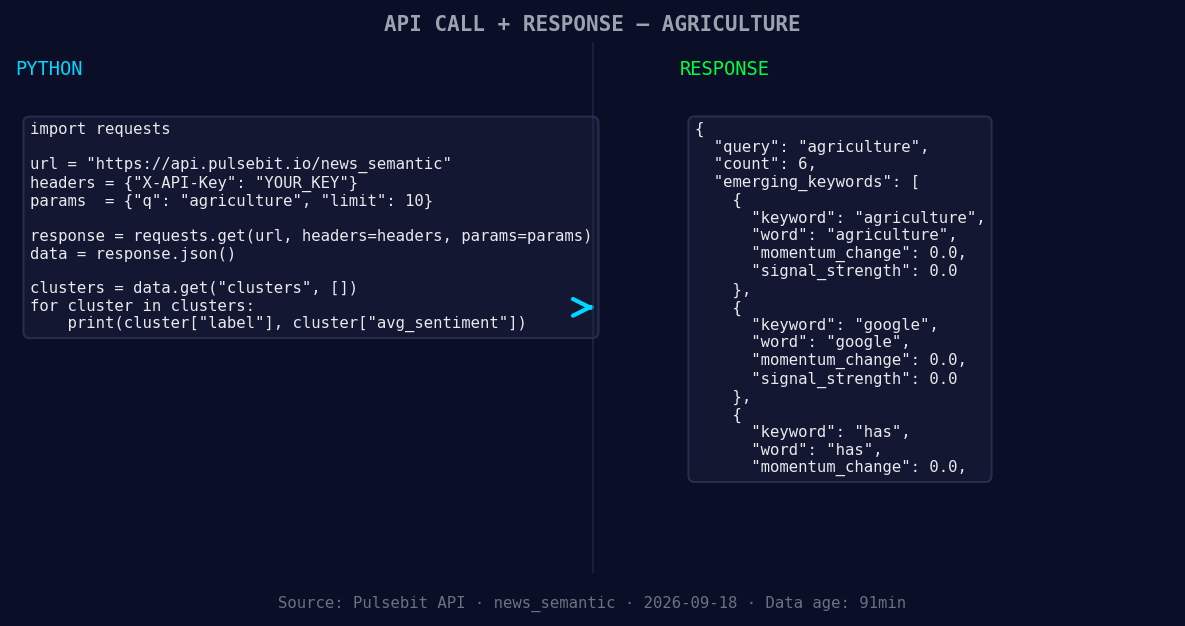
*Left: Python GET /news_semantic call for 'agriculture'. Right: returned JSON response structure (clusters: 3). Source: Pulsebit /news_semantic.*
# Define the parameters for the API query.
topic = 'agriculture'
momentum = +0.167
score = +0.279
confidence = 0.90
# Geographic origin filter to focus on English language articles in the U.S.
url = "https://api.pulsebit.com/v1/articles"
params = {
"topic": topic,
"lang": "en",
"country": "US"
}
response = requests.get(url, params=params)
data = response.json()
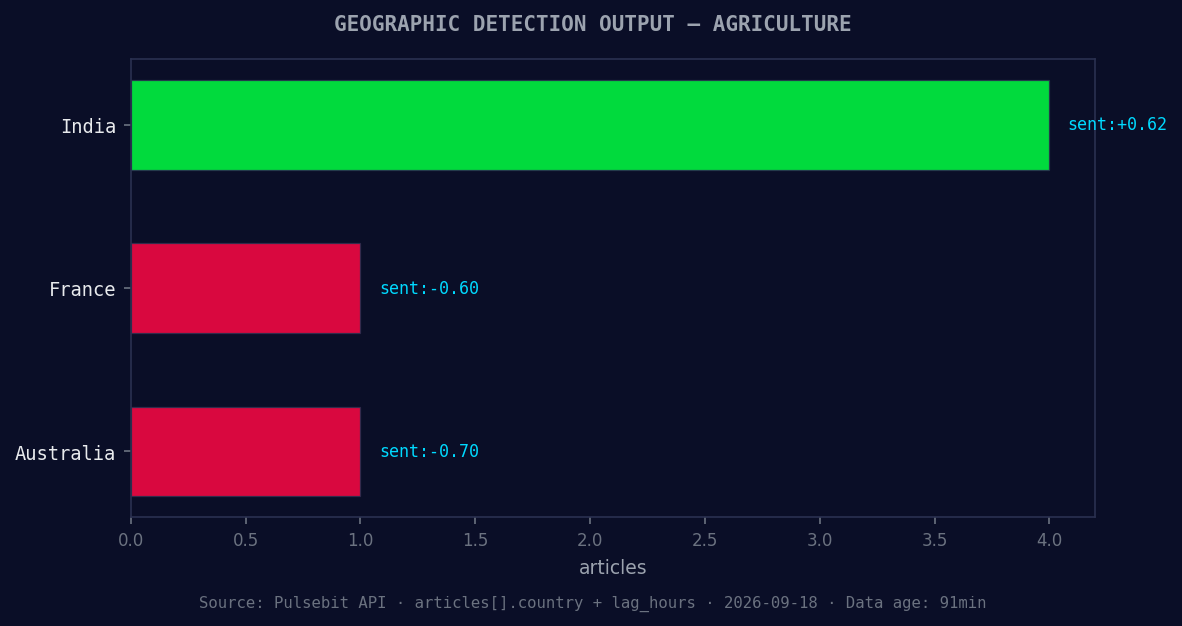
*Geographic detection output for agriculture. India leads with 4 articles and sentiment +0.62. Source: Pulsebit /news_recent geographic fields.*
# Check the response
if response.status_code == 200:
print("Articles processed:", data['articles_processed'])
else:
print("Error fetching data:", response.status_code)
# Now, let's run the cluster reason string back through the sentiment endpoint.
cluster_reason = "Clustered by shared themes: agriculture, secretary, says, farm, bill."
sentiment_url = "https://api.pulsebit.com/v1/sentiment"
sentiment_response = requests.post(sentiment_url, json={"text": cluster_reason})
sentiment_data = sentiment_response.json()
# Display the meta-sentiment score
if sentiment_response.status_code == 200:
print("Meta-Sentiment Score:", sentiment_data['score'])
else:
print("Error fetching sentiment:", sentiment_response.status_code)
This code snippet does two crucial things: it filters for articles in English from the U.S. and assesses the sentiment of the clustered themes. By running the cluster reason string through the sentiment scoring endpoint, you gain insight into how the narrative framing itself is perceived, adding another layer of understanding to your analysis.
Now, considering this data, here are three specific builds to implement tonight:
Signal Detection: Set a threshold for sentiment momentum spikes greater than +0.1 in agriculture. Use the geo filter to ensure you’re capturing English articles from the U.S. This will allow you to flag significant sentiment shifts early.
Meta-Sentiment Analysis: Create a routine that pulls in cluster reasons and scores them using the meta-sentiment loop. You should aim to capture narratives around forming themes like agriculture, as these can lead to actionable insights ahead of mainstream media.
Forming Theme Alerts: Implement a monitoring system for forming themes where you track sentiment around keywords like "agriculture," "google," and "has." Set up alerts when sentiment diverges significantly from mainstream narratives to ensure you’re in tune with emerging conversations.
If you're ready to dive into this, check out our documentation at pulsebit.lojenterprise.com/docs. You can easily copy-paste and run this in under 10 minutes. Don't let your pipeline fall behind any longer; take action on these insights!


Top comments (0)