

Your Pipeline Is 7.9h Behind: Catching Finance Sentiment Leads with Pulsebit
We recently discovered a significant anomaly: a 24-hour momentum spike of +1.050 in finance sentiment. This spike isn’t just a blip; it’s a clear signal that something is brewing in the financial landscape. Given that the leading language is English, with a press lead time of just 7.9 hours, it’s crucial to understand why your current pipeline might be missing the mark.
The problem is straightforward yet critical: if your model doesn’t account for multilingual origins or entity dominance, you’re lagging behind by nearly 8 hours. The dominant entity in this case is Yahoo Finance, accounting for 16% of the share of voice with a positive sentiment score of +0.513. If your pipeline isn't tuned to catch these nuances, you’re effectively 7.9 hours late to a critical financial conversation.

English coverage led by 7.9 hours. Da at T+7.9h. Confidence scores: English 0.80, French 0.80, Spanish 0.80 Source: Pulsebit /sentiment_by_lang.
Here’s how we can catch this momentum spike using our API. The following Python code demonstrates how to filter for finance-related sentiment in English and then analyze the meta-sentiment of clustered narratives.
import requests
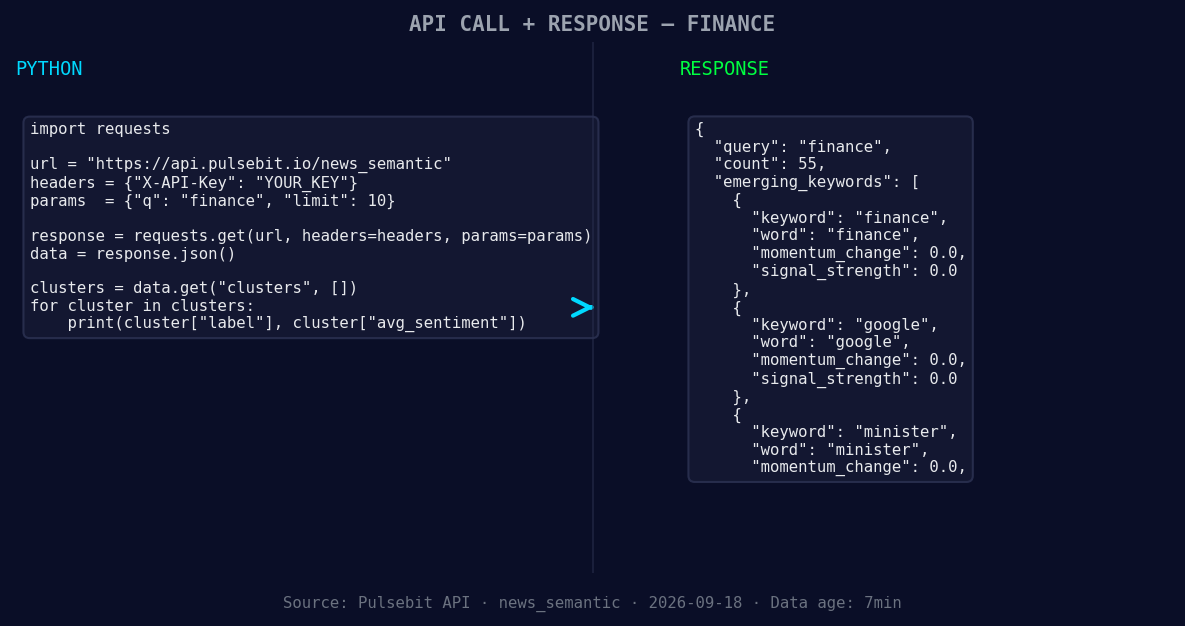
*Left: Python GET /news_semantic call for 'finance'. Right: returned JSON response structure (clusters: 3). Source: Pulsebit /news_semantic.*
# Step 1: Geographic origin filter
url = "https://api.pulsebit.lojenterprise.com/v1/sentiment"
params = {
"topic": "finance",
"score": +0.057,
"confidence": 0.80,
"momentum": +1.050,
"lang": "en" # Filter for English language
}
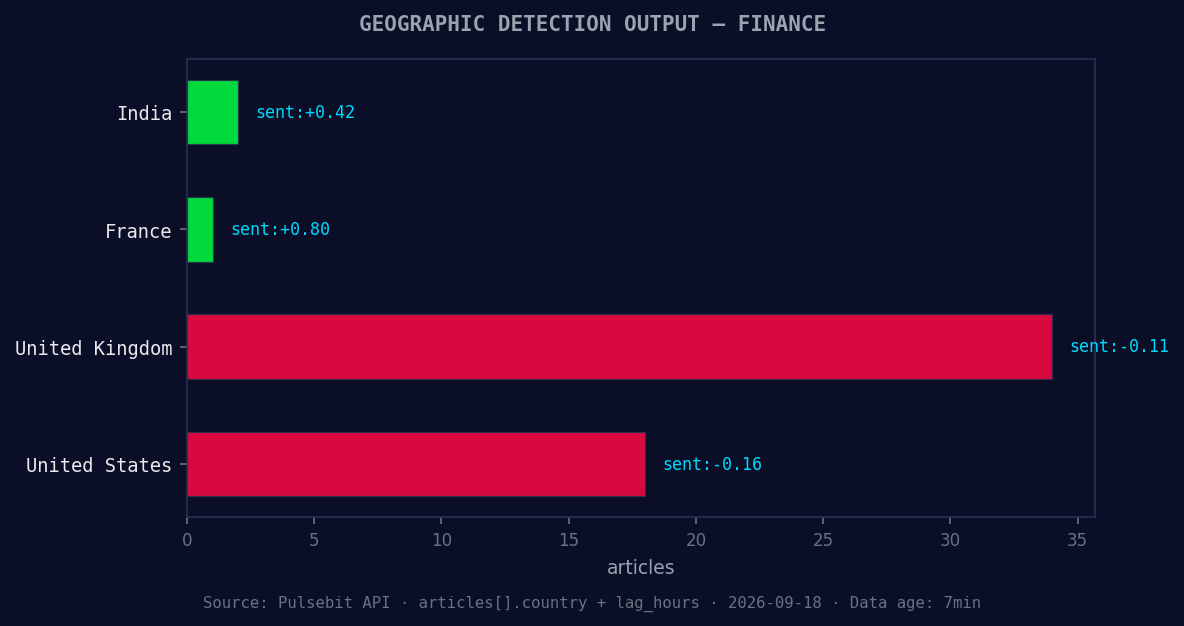
*Geographic detection output for finance. India leads with 2 articles and sentiment +0.42. Source: Pulsebit /news_recent geographic fields.*
response = requests.get(url, params=params)
data = response.json()
# Displaying the response
print(data)
# Step 2: Meta-sentiment moment
cluster_reason = "Clustered by shared themes: blackline, leaders, reinvention, accenture, finance."
meta_sentiment_url = "https://api.pulsebit.lojenterprise.com/v1/sentiment"
meta_response = requests.post(meta_sentiment_url, json={"text": cluster_reason})
# Displaying the meta-sentiment response
print(meta_response.json())
This code snippet captures the essence of what we’re discussing. The first part filters for finance sentiment in English, ensuring you're focused on the right audience. The second part sends the cluster reason string back through the API to derive the sentiment of the narrative itself. This two-step approach allows us to not just react, but proactively understand the framing around the sentiment.
Now let’s consider three specific builds you can create around this pattern:
Geographic Origin Filter: Utilize the geo filter to build an alert system that triggers when finance sentiment spikes above a predefined threshold (+1.000) in English-speaking regions. This allows you to catch emerging trends early.
Meta-Sentiment Loop: Create an analytical dashboard that continuously runs the meta-sentiment loop on clustered narratives. Use a threshold of +0.500 to gauge sentiment shifts in narratives like the recent one about finance. This helps you understand how narratives evolve over time.
Forming Themes Monitor: Develop a monitoring tool that tracks forming themes such as finance (+0.00), google (+0.00), and minister (+0.00). Set alerts for when these themes start crossing paths with mainstream topics like blackline, leaders, and reinvention, which can indicate larger shifts in sentiment.
These builds leverage the data we’ve gathered and allow for actionable insights that keep you ahead of the curve.
If you’re ready to dive in, head over to our documentation: pulsebit.lojenterprise.com/docs. You can copy-paste the code above and run it in under 10 minutes, giving you a head start on the latest financial sentiment trends.


Top comments (0)