

Your Pipeline Is 22.1h Behind: Catching World Sentiment Leads with Pulsebit
We discovered a striking anomaly: a 24h momentum spike of +0.653. This surge isn't just a minor blip; it's a significant indicator of rising sentiment around global topics. The leading language is English, with a 22.1-hour lead. This tells us something essential — if your pipeline isn’t set up to handle multilingual origins or entity dominance, it could be lagging by over 22 hours in recognizing critical shifts in sentiment.

English coverage led by 22.1 hours. Da at T+22.1h. Confidence scores: English 0.90, French 0.90, Spanish 0.90 Source: Pulsebit /sentiment_by_lang.
Imagine this: your model missed this spike while it focused on mainstream narratives, with a dominant entity being China, which accounts for 7% of the share of voice and carries a positive sentiment score of +0.415. This structural gap can lead to missed opportunities, as you’re not seeing the complete picture of how sentiment is evolving globally.
To catch this momentum spike, we can leverage our API effectively. Here’s how you can query for this sentiment data using Python:
import requests
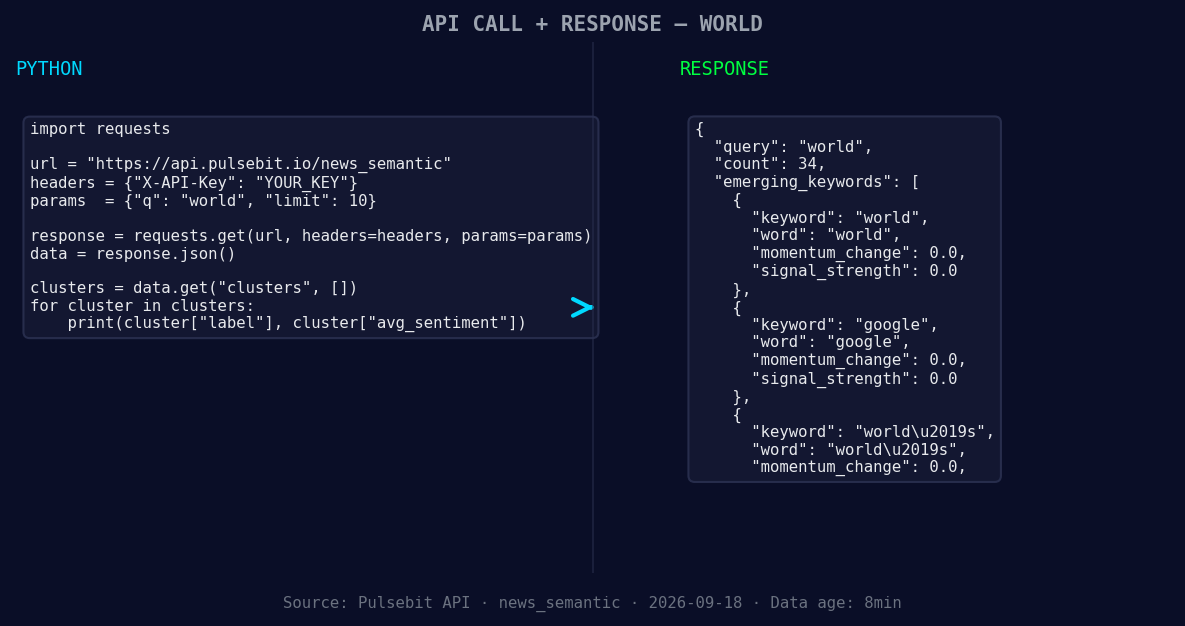
*Left: Python GET /news_semantic call for 'world'. Right: returned JSON response structure (clusters: 3). Source: Pulsebit /news_semantic.*
# Define the parameters for the query
topic = 'world'
score = -0.046
confidence = 0.90
momentum = +0.653
# Geographic origin filter: query by language/country
response = requests.get('https://api.pulsebit.com/sentiment', params={
'topic': topic,
'lang': 'en',
'confidence': confidence,
'momentum': momentum
})
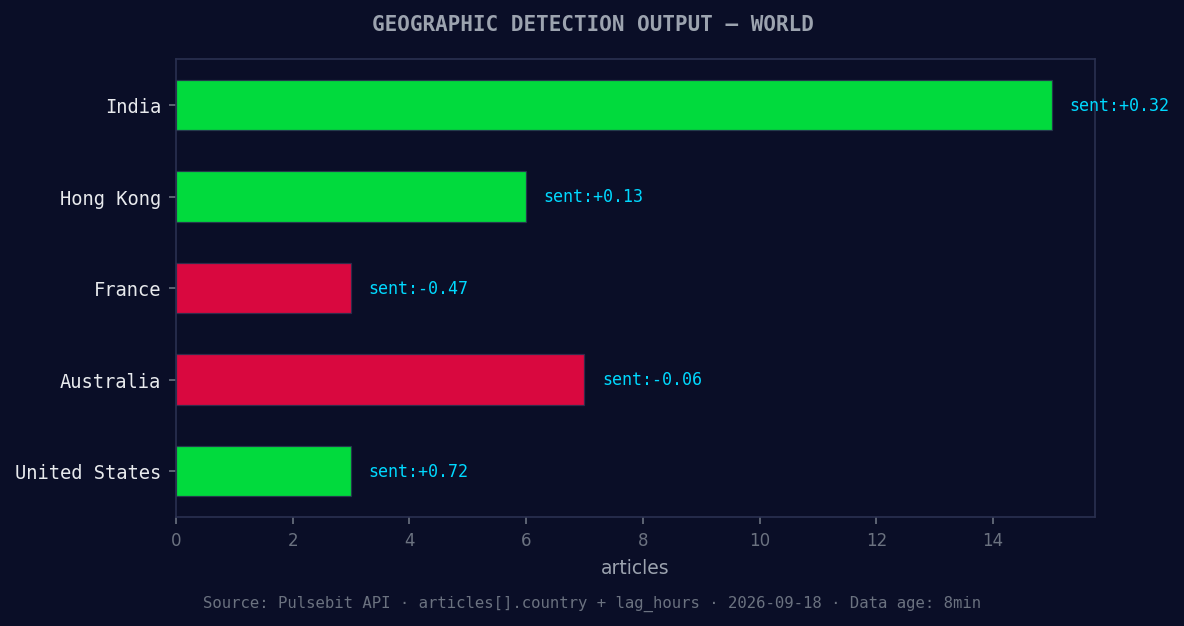
*Geographic detection output for world. India leads with 15 articles and sentiment +0.32. Source: Pulsebit /news_recent geographic fields.*
data = response.json()
# Now, let's run the cluster reason string back through POST /sentiment
cluster_reason = "Clustered by shared themes: vit, vice-president, crown, jewel, world."
sentiment_response = requests.post('https://api.pulsebit.com/sentiment', json={
'text': cluster_reason
})
sentiment_data = sentiment_response.json()
print(sentiment_data)
This code does two essential things. First, it filters sentiment data by the English language, ensuring we focus on the critical narratives emerging from significant geographies. Second, we send the cluster reason string back through our sentiment API to get a deeper understanding of how these themes are connected. This is crucial for framing the narrative around emerging topics like "vit," "vice-president," and "crown," which are forming gaps against mainstream narratives.
Now, let’s discuss three specific builds you can implement using this momentum spike pattern:
Geo Filter Signal: Build a signal detection system that triggers alerts when sentiment momentum exceeds a threshold (e.g., +0.5) for topics like "world." This allows you to focus on emerging narratives from specific regions, especially when they show a strong positive sentiment.
Meta-Sentiment Loop: Create a feedback loop that automatically analyzes cluster themes and scores their framing using our sentiment endpoint. For instance, if you receive a cluster reason string that highlights key entities like "vit," score its sentiment to assess whether the narrative is positive or negative, allowing you to adjust your content strategy in real time.
Comparative Analysis Tool: Develop a tool that compares forming themes against mainstream narratives. For example, analyze how "world" (+0.00) and "google" (+0.00) are performing relative to dominant entities like "vit." This can help you identify emerging trends before they become mainstream, allowing you to stay ahead of the curve.
If you’re ready to dive in, you can get started with our documentation at pulsebit.lojenterprise.com/docs. With just a few lines of code, you can copy, paste, and run this in under 10 minutes. Let’s harness this momentum spike and not let your pipeline fall behind.


Top comments (0)