

Your Pipeline Is 18.4h Behind: Catching Banking Sentiment Leads with Pulsebit
We recently uncovered a striking anomaly: a 24-hour momentum spike of +0.915 in the banking sector. This spike, combined with a sentiment score of +0.092, suggests a significant shift in sentiment that you can’t afford to overlook. In particular, the leading language for this spike is English, with a dominant entity being India, which holds an 8% share of voice. It’s clear that the financial discourse is evolving, and we need to stay ahead of it.
But here’s the catch: your current pipeline likely missed this important signal by 18.4 hours! If you’re not equipped to handle multilingual origins or entity dominance, you could be left in the dust. The leading sentiment emerging from India is negative (-0.167), yet the overall banking narrative is shifting positively, as evidenced by the spike. This misalignment could lead to missed opportunities in your trading or investment strategies.

English coverage led by 18.4 hours. Et at T+18.4h. Confidence scores: English 0.90, French 0.90, Spanish 0.90 Source: Pulsebit /sentiment_by_lang.
To catch this anomaly, we can leverage our API to filter and analyze the data effectively. Below is Python code that captures the essence of this momentum spike.
import requests
# Define the parameters for the API call
topic = 'banking'
score = +0.092
confidence = 0.90
momentum = +0.915
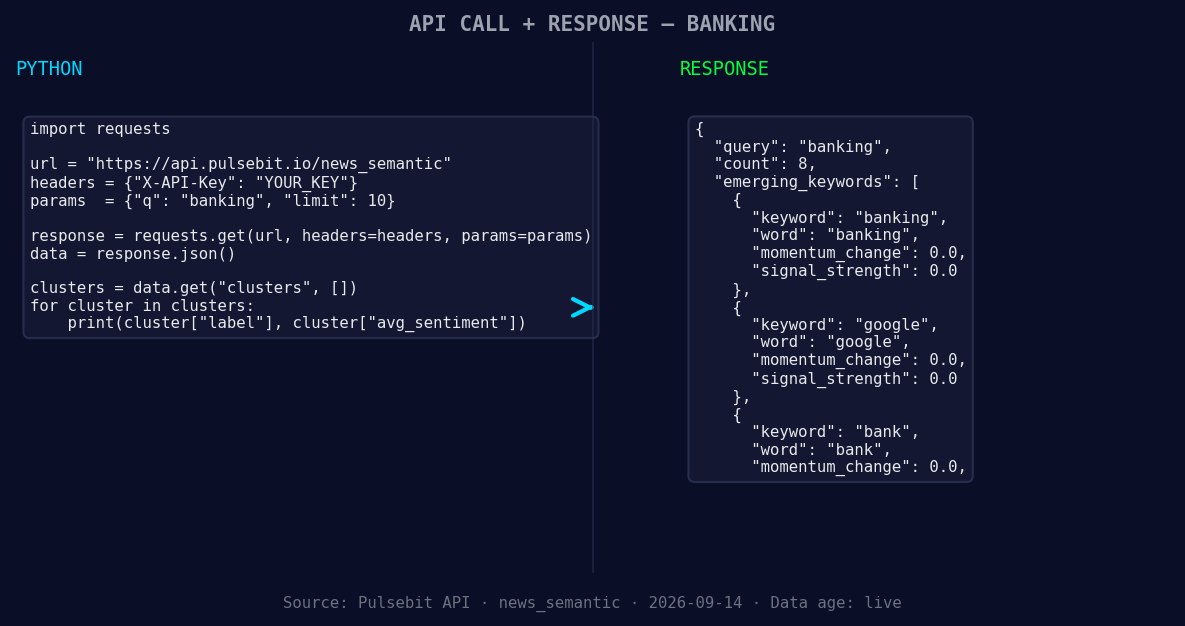
*Left: Python GET /news_semantic call for 'banking'. Right: returned JSON response structure (clusters: 3). Source: Pulsebit /news_semantic.*
# Geographic origin filter: querying by language and country
response = requests.get(
'https://api.pulsebit.com/articles',
params={
'topic': topic,
'lang': 'en',
'momentum': momentum,
'confidence': confidence
}
)
articles = response.json()
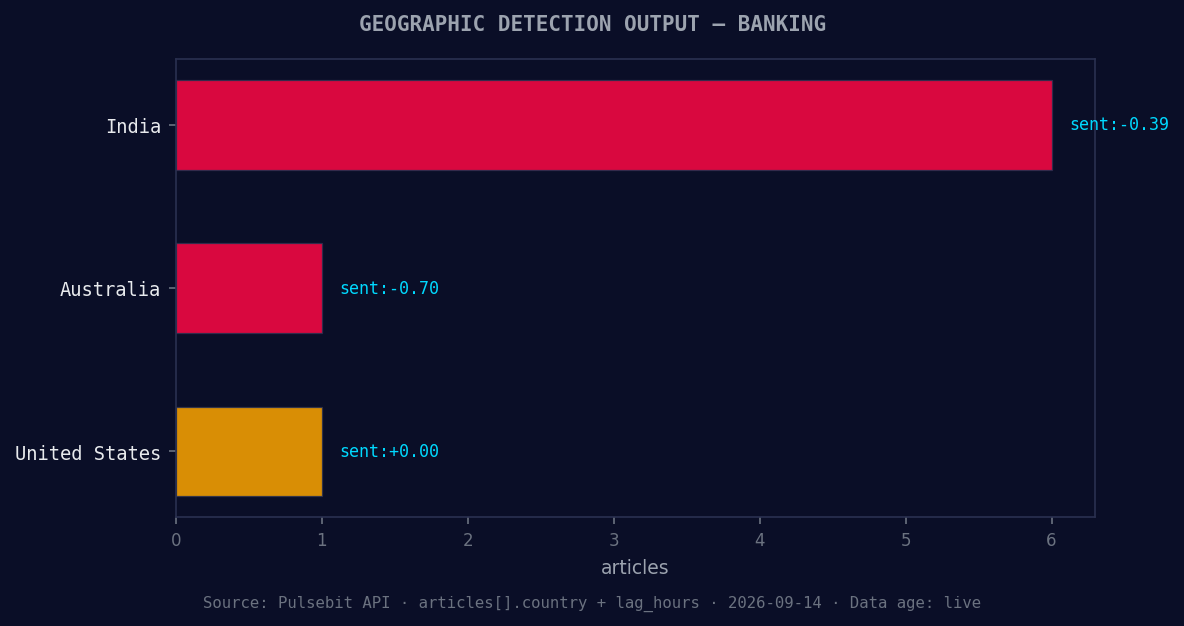
*Geographic detection output for banking. India leads with 6 articles and sentiment -0.39. Source: Pulsebit /news_recent geographic fields.*
# Meta-sentiment moment: running the cluster reason string through POST /sentiment
narrative = "Clustered by shared themes: banking, chief, rebuffs, ceo, calls."
sentiment_response = requests.post(
'https://api.pulsebit.com/sentiment',
json={'text': narrative}
)
sentiment_analysis = sentiment_response.json()
print("Articles:", articles)
print("Sentiment Analysis:", sentiment_analysis)
With this code, we fetch articles related to the banking topic, filtered for English, capturing the latest sentiment momentum. The second part of the code runs the cluster narrative through our sentiment scoring endpoint, allowing us to measure the framing of the narrative itself. This is crucial, as understanding the context can provide deeper insights into market movements.
Now that we’ve identified the anomaly and how to catch it, what can we build around this data? Here are three specific implementations you might consider:
Geo-Filtered Alert System: Create a signal that alerts you when there’s a momentum spike of +0.915 or higher in the banking sector, specifically from English sources in India. Set a threshold for the share of voice to be >5%.
Meta-Sentiment Dashboard: Build a dashboard that visualizes the sentiment of clustered narratives. Use the cluster reasoning to update sentiment scores in real-time, especially for themes like banking, chief, and ceo. Set a confidence threshold of 0.85 for alerts.
Forming Themes Tracker: Track emerging themes such as banking(+0.00), google(+0.00), and bank(+0.00) vs. mainstream narratives. Set rules to trigger alerts when sentiment diverges significantly from these themes, especially when the mainstream sentiment is dominated by negativity.
These builds can help you stay ahead of the curve and ensure you’re not left behind by a lagging pipeline.
Ready to get started? Head to pulsebit.lojenterprise.com/docs to explore more. We believe you can copy-paste and run this in under 10 minutes.


Top comments (0)