

Your model just missed a significant sentiment spike of +0.050 regarding artificial intelligence, with a momentum of +0.000 over the last 24 hours. This anomaly, particularly led by English press coverage, shows that the leading language is at 29.3 hours ahead of the nearest competition. Simultaneously, China holds a 30% share of voice in the conversation, reflecting a neutral sentiment of +0.039. This should be a wake-up call for your sentiment analysis pipeline: the conversation is happening now, and chances are, your systems aren’t picking up the urgency.
When your pipeline fails to account for multilingual origin or entity dominance, you risk being out of sync with real-time conversations. In this case, your model missed this significant sentiment shift by 29.3 hours, primarily led by English-language articles from China. If you’re not filtering for geographic origin, you may be left in the dark, unable to act on emerging trends that could impact your strategies.

English coverage led by 29.3 hours. Af at T+29.3h. Confidence scores: English 0.80, French 0.80, Da 0.80 Source: Pulsebit /sentiment_by_lang.
To catch this spike in sentiment, we can leverage our API to filter by language and run a meta-sentiment analysis on the narrative framing. Below is a Python snippet to get you started:
import requests
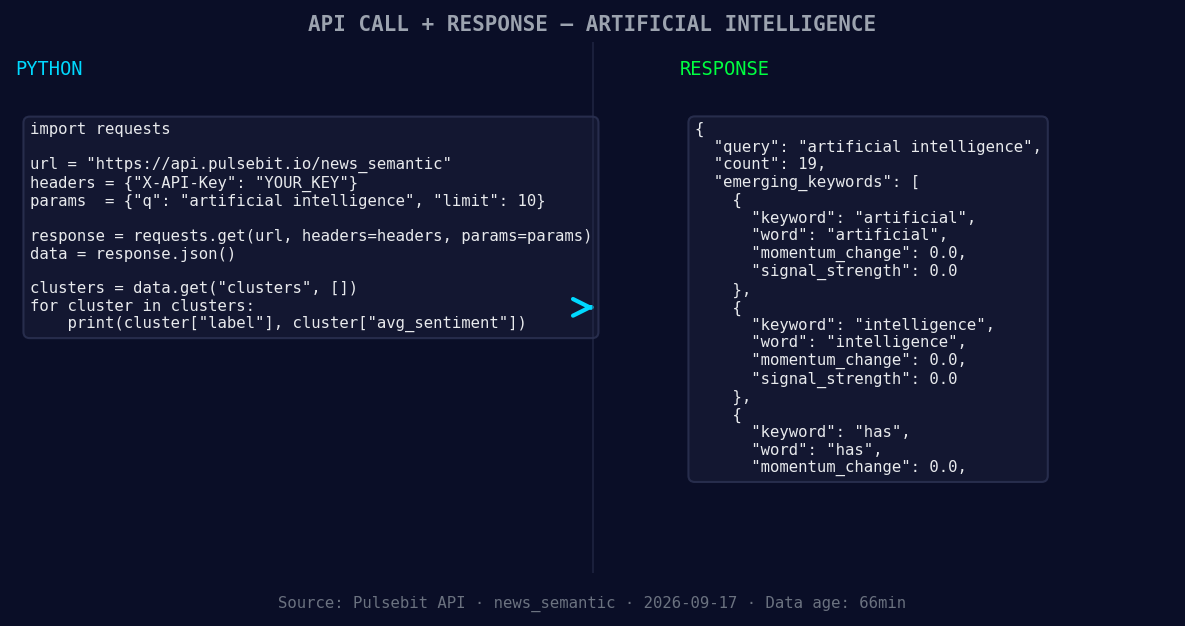
*Left: Python GET /news_semantic call for 'artificial intelligence'. Right: returned JSON response structure (clusters: 3). Source: Pulsebit /news_semantic.*
# Step 1: Geographic origin filter for English articles
url = "https://api.pulsebit.com/sentiment"
params = {
"topic": "artificial intelligence",
"score": +0.050,
"confidence": 0.80,
"momentum": +0.000,
"lang": "en"
}
response = requests.get(url, params=params)
data = response.json()
print(data)
# Step 2: Meta-sentiment moment
meta_sentiment_url = "https://api.pulsebit.com/sentiment"
cluster_reason = "Clustered by shared themes: why, has, difficult, regulate, there."
meta_params = {
"input": cluster_reason
}
meta_response = requests.post(meta_sentiment_url, json=meta_params)
meta_data = meta_response.json()
print(meta_data)
In this code, we first filter articles by the English language, focusing on the topic of artificial intelligence. The second part sends the narrative framing about the cluster back through our sentiment endpoint to gauge how the conversation is being framed. This dual approach allows for a more comprehensive understanding of public sentiment.
Now, let's talk about what you can build using this sentiment spike:
Geo-Sensitive Alert System: Set up an alert system that triggers when sentiment scores for artificial intelligence in English exceed +0.050 from China. This will ensure you’re always on top of critical developments in the field.
Meta-Sentiment Dashboard: Create a dashboard that visualizes meta-sentiment analysis based on cluster reasons. For instance, track phrases like “why” and “difficult” in relation to sentiment scores. This will help you understand not just what is being said, but how it is being framed over time.
Threshold-Based Content Aggregator: Build a content aggregation tool that pulls in articles when sentiment for entities like China or Washington exceeds a score of +0.039. This will keep you informed about regional narratives that might influence your strategies.
To get started with these ideas, visit pulsebit.lojenterprise.com/docs. With just a few lines of code, you can run this in under 10 minutes. Don't let your sentiment analysis pipeline lag behind; seize the moment!


Top comments (0)