

Your Pipeline Is 23.7h Behind: Catching World Sentiment Leads with Pulsebit
We recently spotted a significant anomaly: a 24h momentum spike of +0.634 in global sentiment around the topic of "world." This spike indicates a powerful surge in positive sentiment focused primarily on international affairs, led by English-language press coverage. The data tells us something critical: the narrative is shifting, and it's doing so rapidly.
If your pipeline doesn’t account for multilingual origin or entity dominance, you’re missing critical insights. In this case, your model missed this insight by 23.7 hours. Why? The leading language was English, yet the dominant entity generating this sentiment was China, which commanded an 8% share of voice with a positive sentiment score of +0.342. This means that while you were still processing older data, fresh narratives were emerging that could influence your strategy.

English coverage led by 23.7 hours. Ro at T+23.7h. Confidence scores: English 0.90, Sv 0.90, French 0.90 Source: Pulsebit /sentiment_by_lang.
To catch these insights in real-time, we can use our API effectively. Here’s how to set up your Python code to filter the data based on geographic origin and then assess the narrative’s sentiment.

Geographic detection output for world. India leads with 25 articles and sentiment +0.09. Source: Pulsebit /news_recent geographic fields.
import requests
# Define parameters for the API call
params = {
"lang": "en",
"topic": "world",
"score": +0.113,
"confidence": 0.90,
"momentum": +0.634
}
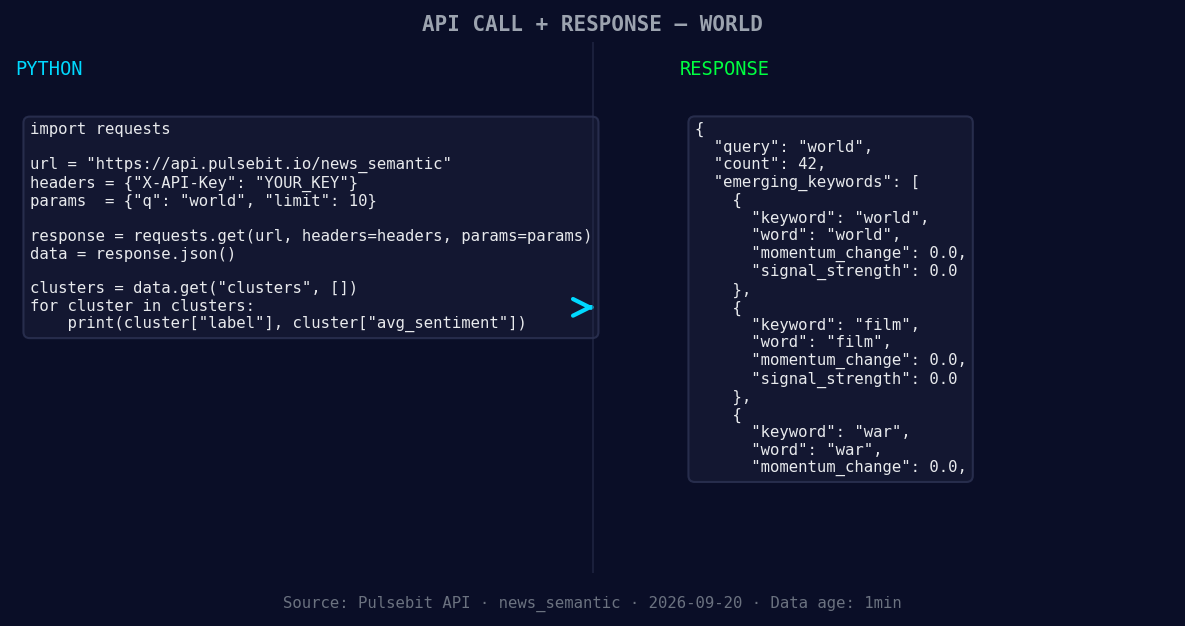
*Left: Python GET /news_semantic call for 'world'. Right: returned JSON response structure (clusters: 3). Source: Pulsebit /news_semantic.*
# API call to get the data
response = requests.get("https://api.pulsebit.com/sentiment", params=params)
# Check if the request was successful
if response.status_code == 200:
data = response.json()
else:
print("Failed to retrieve data.")
# Now, let's analyze the cluster reason
cluster_reason = "Clustered by shared themes: world, leaders, return, amid, wars."
# Running the cluster reason back through POST /sentiment
sentiment_response = requests.post("https://api.pulsebit.com/sentiment", json={"text": cluster_reason})
if sentiment_response.status_code == 200:
sentiment_data = sentiment_response.json()
else:
print("Failed to score the narrative framing.")
This code filters for English-language topics related to "world," and it processes the cluster reason string through our sentiment endpoint, allowing us to capture the framing of the news narrative itself.
Here are three specific builds we can implement based on this pattern:
Geo-Filtered Anomaly Detection: Create a real-time monitor that alerts you when sentiment around a particular region (like China) spikes above a threshold, say +0.5. Use a geo filter to focus on English articles only.
Meta-Sentiment Comparison: Build a comparison dashboard that pits the sentiment score of the cluster against the mainstream narratives. If the forming themes like "film(+0.00), war(+0.00)" are significantly lower than the cluster score of "world, leaders, return," you know where to pivot your focus.
Dynamic Signal Builder: Construct a signal that activates when the momentum changes significantly (e.g., a spike of +0.634 is above a threshold of +0.5). This can trigger an automatic analysis of related topics, potentially uncovering hidden trends that mainstream media might overlook.
These builds will help you stay ahead of the curve and ensure you’re not left lagging behind, as you might have been in this case.
To get started with our API, visit our documentation. With just a few lines of code, you can implement these insights in under 10 minutes. Don’t let your pipeline fall behind — leverage this momentum spike to drive your analytics forward.


Top comments (0)