

Your Pipeline Is 17.1h Behind: Catching Crypto Sentiment Leads with Pulsebit
We recently discovered a critical anomaly in our sentiment analysis: a sentiment score of -0.083 combined with a momentum of +0.000 regarding the topic of crypto. This has raised flags for us, especially with the context of the recent Bitget crypto exchange hack, which has been the focus of multiple articles. With the leading language at 17.1h (0.0h lag vs. Italian), it’s clear that there’s an urgent need to address how we’re processing multilingual origin and entity dominance in our pipelines.

English coverage led by 17.1 hours. Italian at T+17.1h. Confidence scores: English 0.90, Spanish 0.90, French 0.90 Source: Pulsebit /sentiment_by_lang.
Your model missed this by 17.1 hours. That’s a significant gap when you consider that the dominant entity currently discussed is South Africa with a 14% share of voice. If you’re not capturing these multilingual narratives effectively, you risk falling behind on crucial insights. The leading language—English—has been overshadowed by the Italian conversation, illustrating a structural gap that can have serious implications for your analytics and decision-making process.
To catch these anomalies, we can leverage our API effectively. Here's a snippet of Python code that demonstrates how to fetch relevant sentiment data while focusing on the specific language criteria.
import requests
# API call to retrieve sentiment data for the topic 'crypto'
url = "https://api.pulsebit.com/sentiment"
params = {
"topic": "crypto",
"score": -0.083,
"confidence": 0.90,
"momentum": +0.000,
"lang": "en"
}
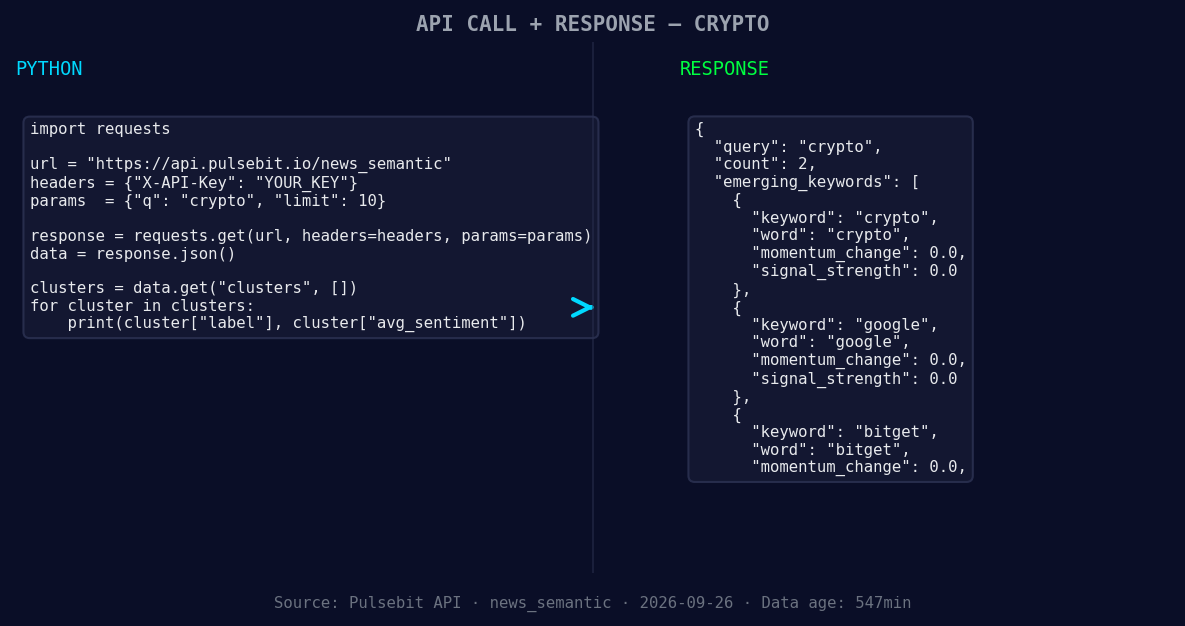
*Left: Python GET /news_semantic call for 'crypto'. Right: returned JSON response structure (clusters: 3). Source: Pulsebit /news_semantic.*
response = requests.get(url, params=params)
data = response.json()
# Printing the response from the API
print(data)
Next, we need to run a meta-sentiment analysis on the cluster reason string to better understand narrative framing. This is critical for identifying how these themes are being discussed across platforms:
# Running meta-sentiment on the cluster reason string
meta_sentiment_url = "https://api.pulsebit.com/sentiment"
meta_params = {
    "text": "Clustered by shared themes: bitget, les, cryptomonnaies, plateforme, victime."
}

meta_response = requests.post(meta_sentiment_url, json=meta_params)
meta_data = meta_response.json()

# Printing the meta sentiment response
print(meta_data)
With these insights in hand, here are three specific builds you can create tonight to leverage this data:
Geo-Filter Alerting: Set up an alert system that triggers when sentiment scores dip below -0.08 specifically for South Africa. This will help you catch emerging narratives before they trend.
Meta-Sentiment Analyzer: Build a module that continuously feeds the latest cluster reason strings into our meta-sentiment loop. You can set a threshold for when the sentiment score drops below -0.08, alerting your team to potential crisis scenarios.
Forming Theme Tracker: Create a dashboard that tracks forming themes in real-time. Focus on the keywords: crypto, google, and bitget. If any of these reach a momentum of +0.00, alert your team to potential discussions gaining traction outside traditional channels.
If you’re ready to dive deeper into this, you can explore our API further at pulsebit.lojenterprise.com/docs. In under 10 minutes, you can copy, paste, and run these examples to start catching insights before your competitors do.

Geographic detection output for crypto. France leads with 1 articles and sentiment -0.75. Source: Pulsebit /news_recent geographic fields.


Top comments (0)