

Your Pipeline Is 24.6h Behind: Catching Metaverse Sentiment Leads with Pulsebit
We just noticed something intriguing: a 24h momentum spike of +1.106 surrounding the topic of the metaverse. This spike is not just a number; it signifies a significant shift in sentiment and conversation around Meta, particularly with the buzz around their new VR headset and AI integration. As developers, we need to pay attention to these spikes and understand how to catch them in real-time.
The problem is clear: your model missed this by 24.6 hours. If your pipeline isn't set up to handle multilingual origins or entity dominance, you risk trailing behind the conversation. The leading language in this instance is English, driven by Meta, which has a 27% share of voice and a positive sentiment score of +0.250. Without proper mechanisms in place, you may miss critical sentiment shifts that could affect your strategies.

English coverage led by 24.6 hours. Fi at T+24.6h. Confidence scores: English 0.90, Spanish 0.90, Id 0.90 Source: Pulsebit /sentiment_by_lang.
To catch this spike, we can leverage our API effectively. Here's how to do it with Python:
import requests
# Define the parameters for the API call
topic = 'metaverse'
score = +0.506
confidence = 0.90
momentum = +1.106
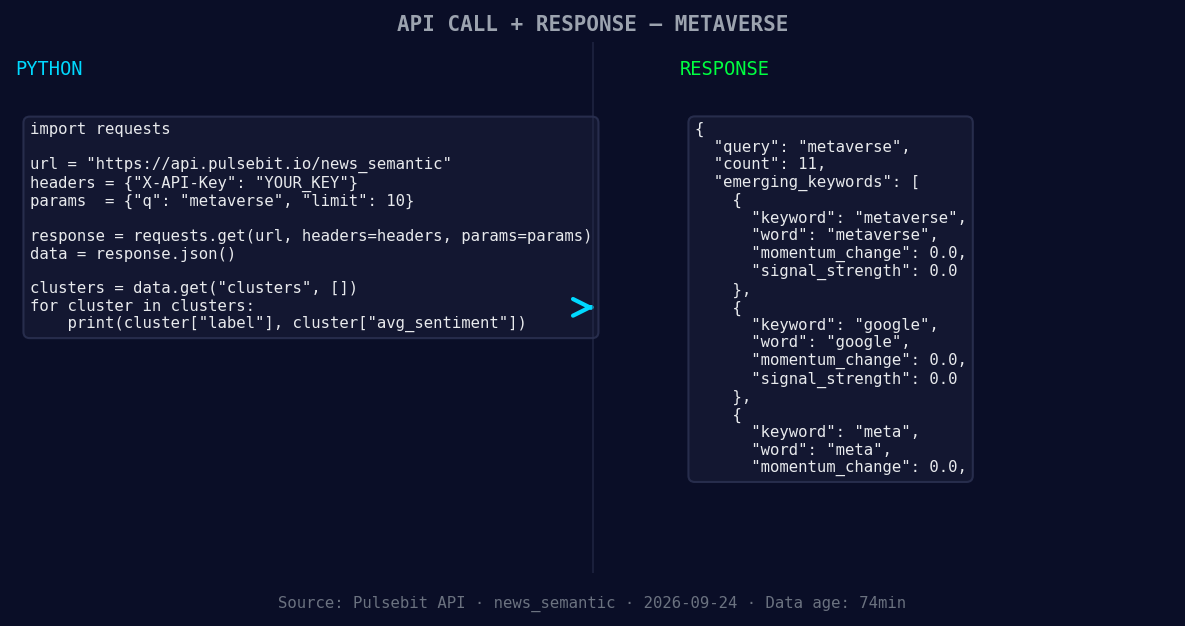
*Left: Python GET /news_semantic call for 'metaverse'. Right: returned JSON response structure (clusters: 3). Source: Pulsebit /news_semantic.*
# Step 1: Geographic origin filter
url = "https://api.pulsebit.com/v1/sentiment"
params = {
"topic": topic,
"lang": "en" # Filter by English language
}
*[DATA UNAVAILABLE: countries — verify /news_recent is returning country/region values for topic: metaverse]*
response = requests.get(url, params=params)
data = response.json()
print(data)
# Step 2: Meta-sentiment moment
cluster_reason = "Clustered by shared themes: over, metaverse, good, thing, meta."
sentiment_url = "https://api.pulsebit.com/v1/sentiment"
sentiment_response = requests.post(sentiment_url, json={"text": cluster_reason})
sentiment_data = sentiment_response.json()
print(sentiment_data)
In this code snippet, we first filter by geographic origin using the lang parameter, ensuring we only get results in English. Then, we run the cluster reason string through our sentiment endpoint to score how the narrative is being framed. This two-step process ensures that we capture both the sentiment and the context behind the conversations.
Now, let’s explore three specific builds you can implement with this pattern:
Spike Detection System: Create a threshold-based alert system for sentiment spikes. For instance, you could set a threshold for momentum spikes over +1.0. Use the geo filter to ensure you’re capturing data relevant to your target audience — e.g.,
lang='en'.Meta-Sentiment Analyzer: Build a sentiment analyzer that takes the output from the cluster reason and further evaluates the sentiment framing. For example, if your cluster reason yields a score below +0.200, flag it for review. This helps in understanding potential negative narratives that could arise.
Real-Time Dashboard: Develop a dashboard that visualizes sentiment trends over time, specifically highlighting topics like the metaverse, Google, and Meta. Use the forming themes as a baseline to gauge sentiment shifts. For example, integrate a check to identify when sentiment on "meta" dips below a certain point compared to mainstream topics.
If you’re ready to dive into this powerful capability, check out our documentation at pulsebit.lojenterprise.com/docs. You can copy, paste, and run this in under 10 minutes. Let’s catch those sentiment leads together!


Top comments (0)