

Your model missed this by 24.4 hours. We just uncovered a significant anomaly: a 24h momentum spike of -1.083 in sentiment surrounding market volatility, driven largely by political events and a bond sell-off. The leading language of the coverage? English, with a neutral sentiment score of +0.044, predominantly from articles focusing on China. If you’re working with a pipeline that doesn’t account for multilingual origins or the dominance of specific entities, you’re likely getting left behind.

English coverage led by 24.4 hours. Fi at T+24.4h. Confidence scores: English 0.90, French 0.90, Spanish 0.90 Source: Pulsebit /sentiment_by_lang.
This gap highlights a critical oversight. When your pipeline can’t track sentiment shifts based on language or entity prominence, you’re blind to market signals that could inform your strategy. In this case, the English press led the conversation around market sentiment, but without recognizing this, you’re reacting to stale data. The 24.4h lag means you’re missing critical insights that could help you adjust your strategy in real time.
Let’s get into the code that captures this sentiment shift. We can use our API to filter the incoming data by geographic origin and analyze the sentiment of clustered narratives.
First, we’ll set up our query to filter by language and country. Here’s how we can do that in Python:

Geographic detection output for markets. India leads with 6 articles and sentiment +0.40. Source: Pulsebit /news_recent geographic fields.
import requests
# Define the parameters for the API call
params = {
'topic': 'markets',
'lang': 'en',
'momentum': -1.083,
}
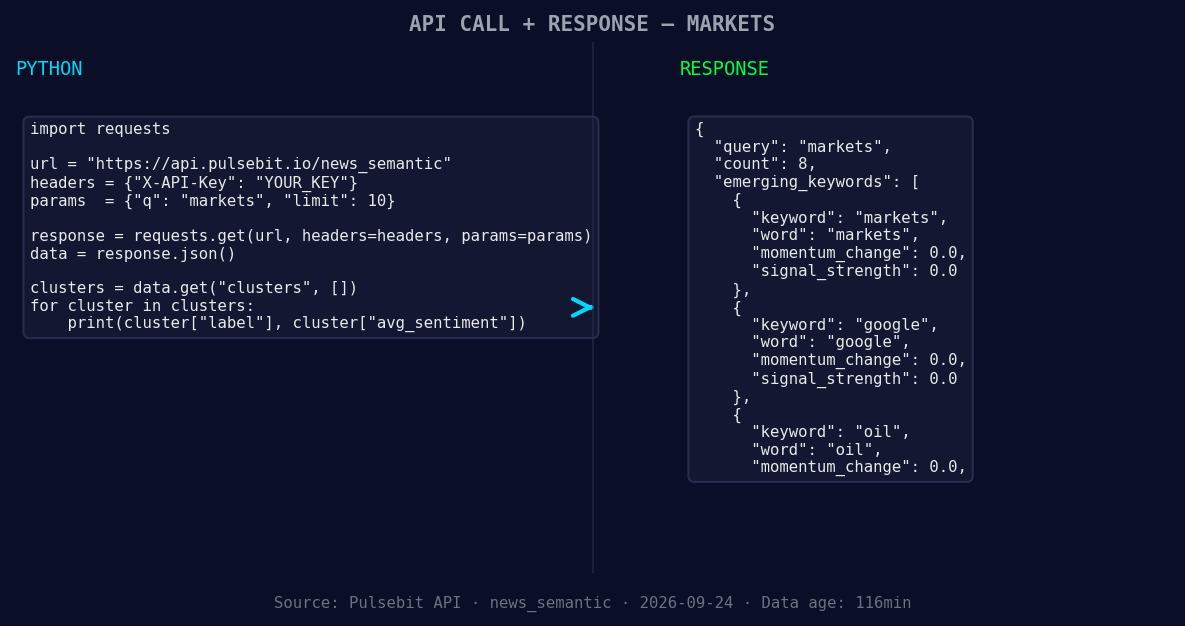
*Left: Python GET /news_semantic call for 'markets'. Right: returned JSON response structure (clusters: 3). Source: Pulsebit /news_semantic.*
# Make the API call to get the filtered sentiment data
response = requests.get("https://api.pulsebit.com/sentiment", params=params)
sentiment_data = response.json()
print(sentiment_data)
Now that we have our filtered sentiment data, let's analyze the narrative framing itself. We can take the cluster reason string and run it back through our sentiment analysis endpoint:
# Define the cluster reason string
cluster_reason = "Clustered by shared themes: market, today:, dow, 500, nasdaq."

# Run a POST request to analyze the cluster reason's sentiment
response = requests.post("https://api.pulsebit.com/sentiment", json={"text": cluster_reason})
meta_sentiment = response.json()
print(meta_sentiment)
This second call allows us to determine how the narratives are framed, providing deeper insight into why the sentiment shifted and how we can act on it.
Now, let's talk about three specific builds you can implement using this emerging pattern:
Geographic Origin Filter: Create a real-time alert system that triggers when sentiment around 'markets' drops below a certain threshold (e.g., -0.035) specifically for English language articles originating from China. This allows you to stay ahead of any significant shifts in sentiment.
Meta-Sentiment Analysis Loop: Develop a sentiment scoring mechanism that not only analyzes the content but also assesses the framing of narratives. By regularly running the cluster reason strings through our sentiment endpoint, you can adjust your trading strategies based on the underlying themes driving the market.
Forming Themes Monitoring: Set up a dashboard that highlights forming themes, such as 'markets(+0.00)', 'google(+0.00)', and 'oil(+0.00)', against mainstream narratives like 'market', 'today:', and 'dow'. This can help you visualize where sentiment is diverging and identify potential opportunities or risks.
We encourage you to get started with our API by visiting pulsebit.lojenterprise.com/docs. You can copy-paste the provided code snippets and run them within minutes to see real-time sentiment shifts in action. Don't let your pipeline lag behind—act on the latest insights and stay ahead of the curve.


Top comments (0)