

Your Pipeline Is 29.2h Behind: Catching Business Sentiment Leads with Pulsebit
In the last 24 hours, we've observed a significant momentum spike of +0.750 in business-related sentiment, particularly driven by English-language articles. This anomaly highlights a crucial shift in sentiment, especially as it relates to the African market where it holds a 15% share of voice and a positive sentiment score of +0.473. What’s particularly intriguing is that while English press led the charge, the German press lagged behind by 29.2 hours. What does this mean for your sentiment analysis pipeline?
If your model isn't designed to handle multilingual content or assess the dominance of specific entities, you could be missing critical insights. Your model missed this shift by 29.2 hours, leaving you behind on a growing narrative around business successes in Africa. This gap is more than just an oversight; it's an opportunity lost to capitalize on emerging trends and sentiment that could influence business decisions.

English coverage led by 29.2 hours. German at T+29.2h. Confidence scores: English 0.90, Spanish 0.90, French 0.90 Source: Pulsebit /sentiment_by_lang.
To catch up with this momentum spike, we can leverage our API to filter and analyze the data efficiently. Here’s how to do it in Python:
import requests
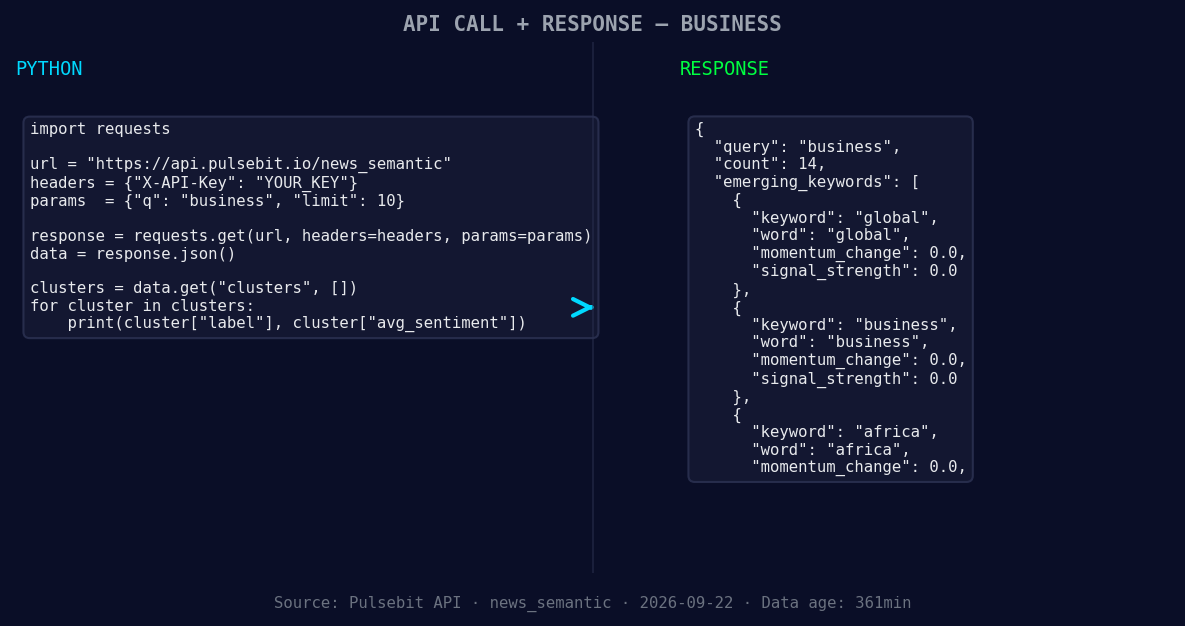
*Left: Python GET /news_semantic call for 'business'. Right: returned JSON response structure (clusters: 3). Source: Pulsebit /news_semantic.*
# Step 1: Geographic origin filter
url = "https://api.pulsebit.lojenterprise.com/v1/sentiment"
params = {
"topic": "business",
"lang": "en",
"score": -0.081,
"confidence": 0.90,
"momentum": +0.750
}
response = requests.get(url, params=params)
business_sentiment = response.json()
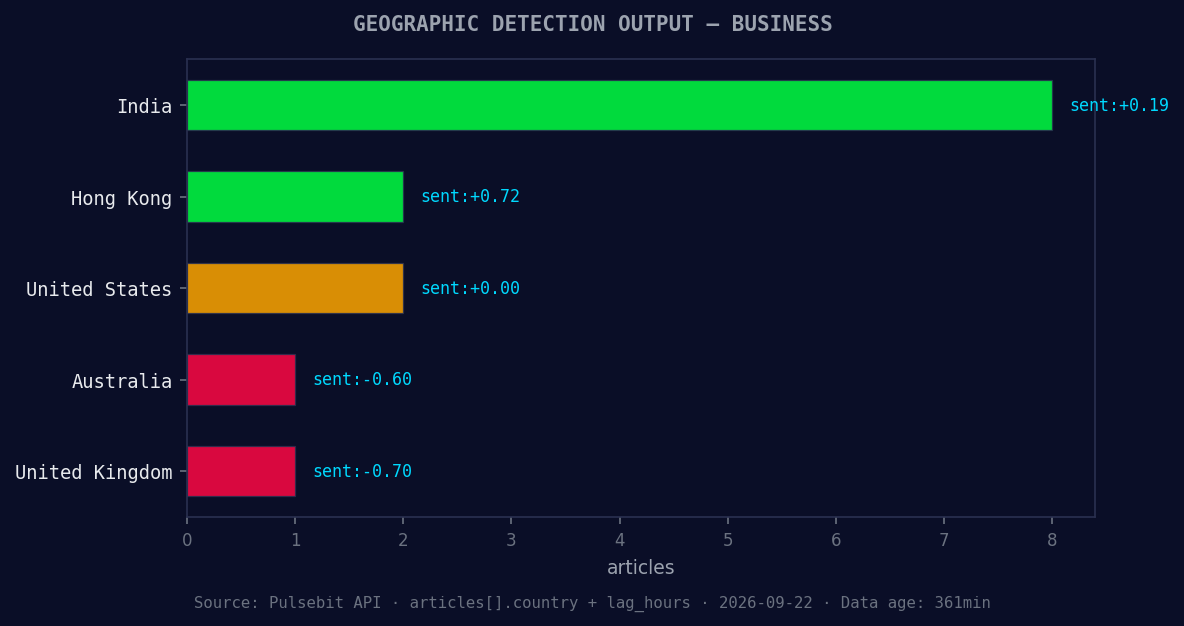
*Geographic detection output for business. India leads with 8 articles and sentiment +0.19. Source: Pulsebit /news_recent geographic fields.*
# Step 2: Meta-sentiment moment
cluster_reason = "Clustered by shared themes: concert, bet, turned, baklava, into."
meta_sentiment_response = requests.post(url, json={"text": cluster_reason})
meta_sentiment = meta_sentiment_response.json()
print("Business Sentiment:", business_sentiment)
print("Meta Sentiment:", meta_sentiment)
In this code, we first query our API to filter for English-language business articles. The parameters include our topic, score, confidence, and the observed momentum spike. Next, we run a POST request to score the narrative framing itself based on the thematic clustering of the articles. This dual approach allows us to not just identify the signal but understand its context more deeply.
Now that we have the momentum spike captured, what can we build with this newfound insight?
Sentiment Alert System: Set a threshold for momentum spikes like +0.750 in the business domain. Create an alert system that triggers when articles exhibit a similar spike, especially when filtered by geographic origin (e.g., "en" for English). This way, you won't miss significant sentiment shifts again.
Dynamic Narrative Analysis: Use the meta-sentiment loop we just implemented to create a dashboard that visualizes the sentiment of narratives over time. This allows you to track how stories evolve based on thematic elements, giving you the ability to anticipate shifts before they become mainstream.
Entity Influence Monitoring: With a focus on dominant entities like Africa in our current analysis, set up an endpoint that continuously monitors sentiment trends around specific entities. For instance, track how articles mentioning "Baklava" impact business sentiment in Africa versus other regions. This could yield insights into local sentiment dynamics versus global narratives.
By implementing these builds, you're not just reacting to sentiment data; you're anticipating trends and gaining a competitive edge.
If you're ready to get started with our API, head over to pulsebit.lojenterprise.com/docs. You can copy-paste the above code and run it in under 10 minutes to uncover the hidden insights waiting in your data streams.


Top comments (0)