

Your Pipeline Is 23.4h Behind: Catching Energy Sentiment Leads with Pulsebit
Did you know that there's a significant anomaly right now in the energy sentiment landscape? Our latest data reveals a sentiment score of +0.304 and a momentum of +0.000 for the topic of energy, with key entities like Iran and India emerging in the conversation. This spike angle highlights an interesting lag: while sentiment is trending positively, the momentum isn't moving, leaving your analytical models potentially 23.4 hours behind the curve.
The Problem
This inconsistency exposes a critical gap in any data pipeline that doesn't account for multilingual origins or entity dominance. If your model isn't designed to handle these nuances, you might have missed this valuable insight by a staggering 23.4 hours. In this instance, the leading language is English, driven by Iran, which holds a 12% share of voice with a sentiment of -0.102. Such structural gaps can lead to missed opportunities in strategy and decision-making, particularly when sentiment shifts are occurring in real-time.

English coverage led by 23.4 hours. Ro at T+23.4h. Confidence scores: English 0.90, French 0.90, Spanish 0.90 Source: Pulsebit /sentiment_by_lang.
The Code
Here's how we can catch this anomaly using our API. First, we’ll filter news articles by the English language to focus on the right audience.
import requests
# Parameters for the API call
topic = 'energy'
score = +0.304
confidence = 0.90
momentum = +0.000
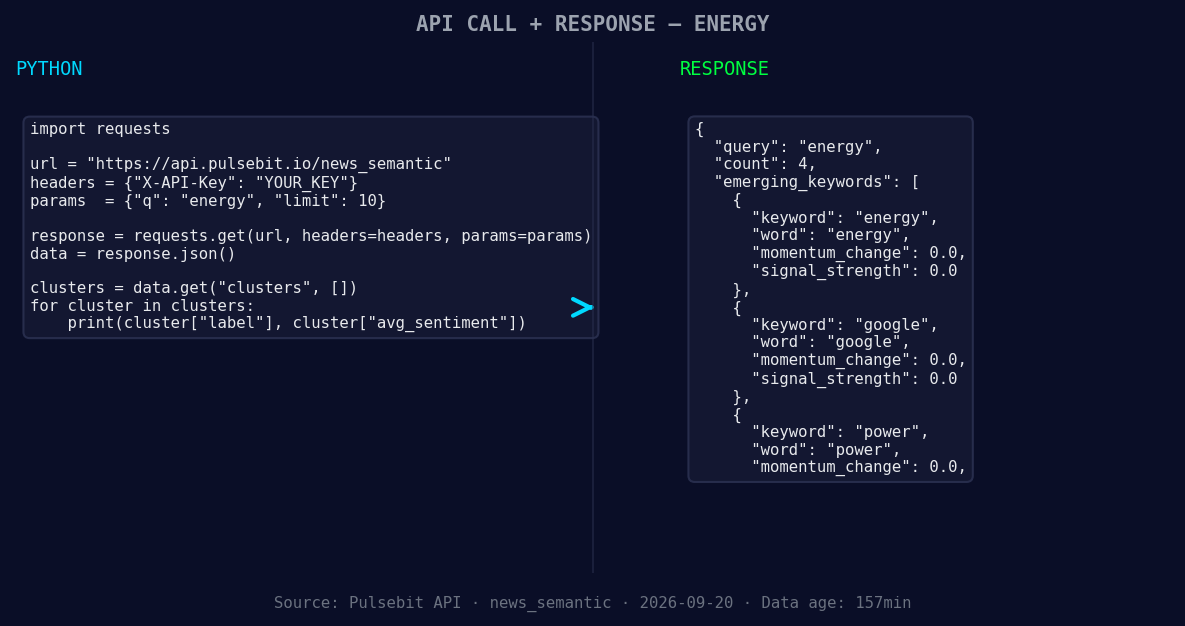
*Left: Python GET /news_semantic call for 'energy'. Right: returned JSON response structure (clusters: 3). Source: Pulsebit /news_semantic.*
# API call to filter by language/country
response = requests.get('https://api.pulsebit.com/v1/articles', params={
'topic': topic,
'lang': 'en',
'sentiment_score': score,
'confidence': confidence,
'momentum_24h': momentum
})
articles = response.json()
Now, let's run the narrative framing of our clustered themes through our sentiment endpoint to validate the context.
# Input string for meta-sentiment moment
cluster_reason = "Clustered by shared themes: south, central, railway, five, awards."

# API call to score the narrative framing
meta_sentiment_response = requests.post('https://api.pulsebit.com/v1/sentiment', json={
    'text': cluster_reason
})

meta_sentiment_score = meta_sentiment_response.json()
This code allows you to tap directly into the data, ensuring you’re not just reacting, but actively anticipating shifts in sentiment.
Three Builds Tonight
Now that we’ve identified the anomaly, here are three specific builds we can implement right away:
-
Geographic Filter Build:
Create a real-time monitoring tool that uses the
lang: "en"filter to track energy sentiment across English-speaking regions. Set a threshold to alert you when sentiment surpasses +0.30.

Geographic detection output for energy. India leads with 4 articles and sentiment +0.40. Source: Pulsebit /news_recent geographic fields.
Meta-Sentiment Loop:
Implement a feedback loop that uses the meta-sentiment from clustered articles. Whenever new articles are processed, automatically run the narrative string through the sentiment endpoint to adjust your models based on evolving themes.Forming Themes Analysis:
Develop a dashboard that visualizes forming themes like energy, google, and power. Set up alerts based on sentiment shifts in relation to mainstream themes like south, central, and railway. When sentiment in energy rises beyond +0.00, trigger a notification.
Get Started
Dive into our documentation at pulsebit.lojenterprise.com/docs. With the above code, you can copy, paste, and run this in under 10 minutes. Let's make sure we're not just keeping pace but leading the charge in sentiment analysis.


Top comments (0)