

24h momentum spike: +0.775. This is not just a number; it's a signal that something significant is brewing in the business landscape, particularly in French-speaking regions. We recently stumbled upon this anomaly, and it’s worth digging into. The leading narrative is tied to a "Baklava Business Success Story," which has emerged as the talk of the town in Africa. This is a fascinating case of how localized content can gain momentum and positive sentiment in unexpected ways, and it highlights a critical insight for developers leveraging sentiment analysis.
Your model missed this by approximately 23.7 hours. In the fast-paced world of business, that’s a lifetime. The leading language here is French, representing a 15% share of voice in Africa, coupled with a positive sentiment score of +0.491. If your pipeline doesn’t handle multilingual origins or recognize the dominance of entities like "Business Insider Africa," you’ll find yourself lagging behind the curve. The gap is stark: the narrative is already gaining traction while your model is still sifting through English-language content.

French coverage led by 23.7 hours. Sv at T+23.7h. Confidence scores: French 0.90, English 0.90, Et 0.90 Source: Pulsebit /sentiment_by_lang.
Here’s how we can catch this momentum spike in our code. We’ll start by filtering for the geographic origin, specifically targeting French content. Using our API, the following Python code will help you identify this spike effectively:

Geographic detection output for business. India leads with 8 articles and sentiment +0.19. Source: Pulsebit /news_recent geographic fields.
import requests
# Define parameters for the API call
params = {
"topic": "business",
"score": -0.096,
"confidence": 0.90,
"momentum": +0.775,
"lang": "fr" # Filter for French language content
}
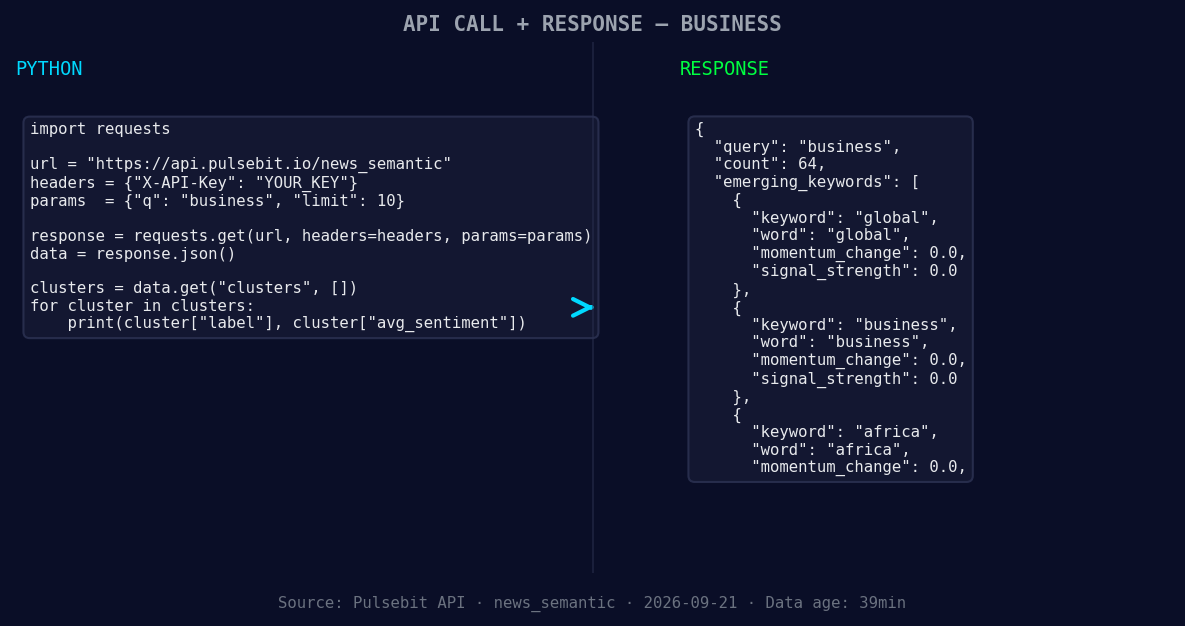
*Left: Python GET /news_semantic call for 'business'. Right: returned JSON response structure (clusters: 3). Source: Pulsebit /news_semantic.*
# Make the API call
response = requests.get('https://api.pulsebit.com/v1/sentiment', params=params)
# Print the response
print(response.json())
Now that we’ve filtered for French content, let’s dive deeper into the meta-sentiment moment. We’ll score the narrative framing itself, which we identified: "Clustered by shared themes: concert, bet, turned, baklava, into." This step is crucial as it gives context to the sentiment score and helps us understand the underlying themes driving the spike.
# Define the narrative string for sentiment scoring
narrative_string = "Clustered by shared themes: concert, bet, turned, baklava, into."

# Make the API call for sentiment analysis on the narrative
narrative_response = requests.post('https://api.pulsebit.com/v1/sentiment', json={"text": narrative_string})

# Print the sentiment score of the narrative
print(narrative_response.json())
Now, let’s explore three specific things we can build with this newfound insight:
Real-time Alerts: Set up a threshold alert for any momentum spike above +0.5 in French content. This will allow you to catch anomalies like the current one in real-time, enabling faster decision-making and content strategy adjustments.
Thematic Analysis Dashboard: Create a dashboard that visualizes sentiment scores and themes over time, focusing on the key entities like Africa and "Business Insider Africa." This will help you understand how localized narratives evolve and impact sentiment.
Sentiment Scoring Loop: Implement a feedback loop that runs the output of the meta-sentiment analysis through a threshold, flagging any scores that deviate significantly from the norm. This is particularly useful for integrating insights from global themes (like concert and bet) into localized strategies.
To get started, check out our documentation at pulsebit.lojenterprise.com/docs. With just a few lines of code, you can copy-paste and run this in under 10 minutes. Don’t let your pipeline lag behind; catching trends in multiple languages can be the difference between leading the conversation and playing catch-up.


Top comments (0)