

Your Pipeline Is 22.8h Behind: Catching Forex Sentiment Leads with Pulsebit
We recently encountered a remarkable anomaly in our data: a 24-hour momentum spike of +0.494. This spike signals a significant shift in sentiment around the forex topic, particularly led by English-language articles. With this momentum, we see a clear opportunity to capitalize on emerging trends in forex that may have otherwise slipped through the cracks of your existing pipeline.
However, if your model doesn’t accommodate for multilingual origins or account for dominant entities, it might have missed this actionable insight by a staggering 22.8 hours. In our case, the leading language was English, and the dominant entity was FOREX.com, which held a 24% share of voice with a positive sentiment score of +0.340. This gap highlights a critical flaw in many sentiment analysis pipelines: they often lack the ability to adjust for language nuances and the influence of major players in the market.

English coverage led by 22.8 hours. Et at T+22.8h. Confidence scores: English 0.90, Spanish 0.90, French 0.90 Source: Pulsebit /sentiment_by_lang.
To address this, we can implement a simple Python script that leverages our API to catch these trends in real-time. Here’s how we can do it:
import requests
# Step 1: Geographic origin filter
url = "https://api.pulsebit.com/sentiment"
params = {
"topic": "forex",
"lang": "en",
"score": +0.261,
"confidence": 0.90,
"momentum": +0.494
}
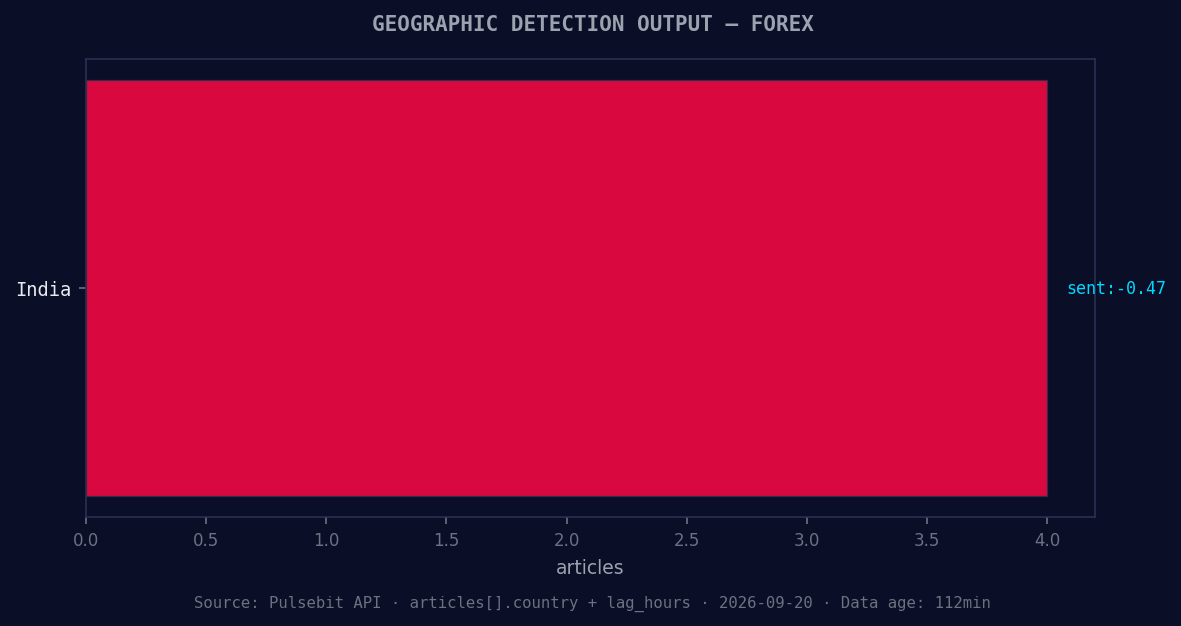
*Geographic detection output for forex. India leads with 4 articles and sentiment -0.47. Source: Pulsebit /news_recent geographic fields.*
response = requests.get(url, params=params)
data = response.json()
print(data)
Now, we need to evaluate the sentiment narrative itself. Let’s run the cluster reason string back through the sentiment endpoint to score the framing:
# Step 2: Meta-sentiment moment
url_meta = "https://api.pulsebit.com/sentiment"
meta_params = {
    "input": "Clustered by shared themes: open, indicative, forex, prices, september."
}

meta_response = requests.post(url_meta, json=meta_params)
meta_data = meta_response.json()
print(meta_data)
With these two API calls, you can catch not just the spike in sentiment but also gain insights into the narrative framing driving it.

Left: Python GET /news_semantic call for 'forex'. Right: returned JSON response structure (clusters: 3). Source: Pulsebit /news_semantic.
Now, let’s explore three actionable builds we can create using this momentum spike:
Geo-Filtered Alert System: Build a notification system that triggers whenever there’s a significant positive sentiment spike in the forex domain, specifically filtering for English language articles. Set a threshold for momentum above +0.400 to ensure you capture only the most relevant spikes.
Meta-Sentiment Dashboard: Create a dashboard that dynamically displays sentiment scores against meta-narratives. Use the output from the meta-sentiment moment to visualize how various narratives evolve over time. This can help you identify which themes are gaining traction, such as "forex," "major," or "open."
Cluster Analysis Tool: Develop a tool that analyzes clusters of articles based on shared themes. Use the output from the cluster reason to compare how sentiment diverges between mainstream and niche topics. For instance, run comparative analyses for "forex(+0.00)" versus mainstream topics like "open" and "indicative."
By leveraging these builds, you can ensure your sentiment analysis pipeline is attuned to the latest market movements and not lagging behind by more than 22 hours.
To get started with our API, visit pulsebit.lojenterprise.com/docs. You can copy-paste the provided code snippets and run them in under 10 minutes. Let’s take advantage of this anomaly and stay ahead of the curve.


Top comments (0)