

Your Pipeline Is 24.0h Behind: Catching Culture Sentiment Leads with Pulsebit
We recently stumbled upon an intriguing anomaly: a 24h momentum spike of +0.297 in cultural sentiment, specifically tied to local festivals enhancing Ithaca's cultural identity. This spike showcases how sentiment can shift dramatically over a short period, providing a unique opportunity for those of us keen on leveraging cultural narratives to inform decision-making processes.
The problem here is glaring. If your pipeline isn't adept at handling multilingual origins or recognizing dominant entities, you missed this cultural shift by a full 24 hours. The leading language for this sentiment is English, but what if your model only focuses on dominant voices in other languages or entities? In this case, Monde is at the forefront, representing a 5% share of voice with a positive sentiment score of +0.180. Your model may have overlooked this valuable sentiment simply due to a lack of linguistic sensitivity or entity tracking.

English coverage led by 24.0 hours. Fi at T+24.0h. Confidence scores: English 0.90, French 0.90, Af 0.90 Source: Pulsebit /sentiment_by_lang.
To catch these critical shifts, we can utilize our API effectively. Here’s a Python snippet that demonstrates how to pinpoint this cultural sentiment using the relevant parameters:
import requests
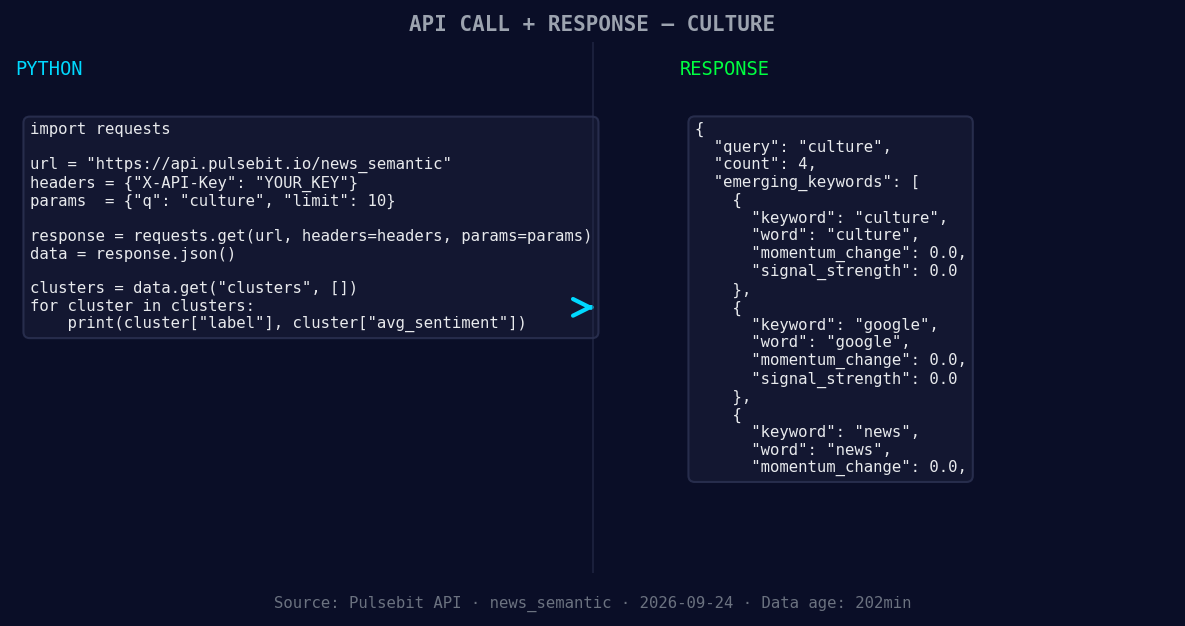
*Left: Python GET /news_semantic call for 'culture'. Right: returned JSON response structure (clusters: 3). Source: Pulsebit /news_semantic.*
# Define parameters
topic = 'culture'
score = +0.350
confidence = 0.90
momentum = +0.297
# Geographic origin filter
response = requests.get(
'https://api.pulsebit.com/sentiment',
params={
'topic': topic,
'lang': 'en',
'momentum': momentum,
'confidence': confidence
}
)
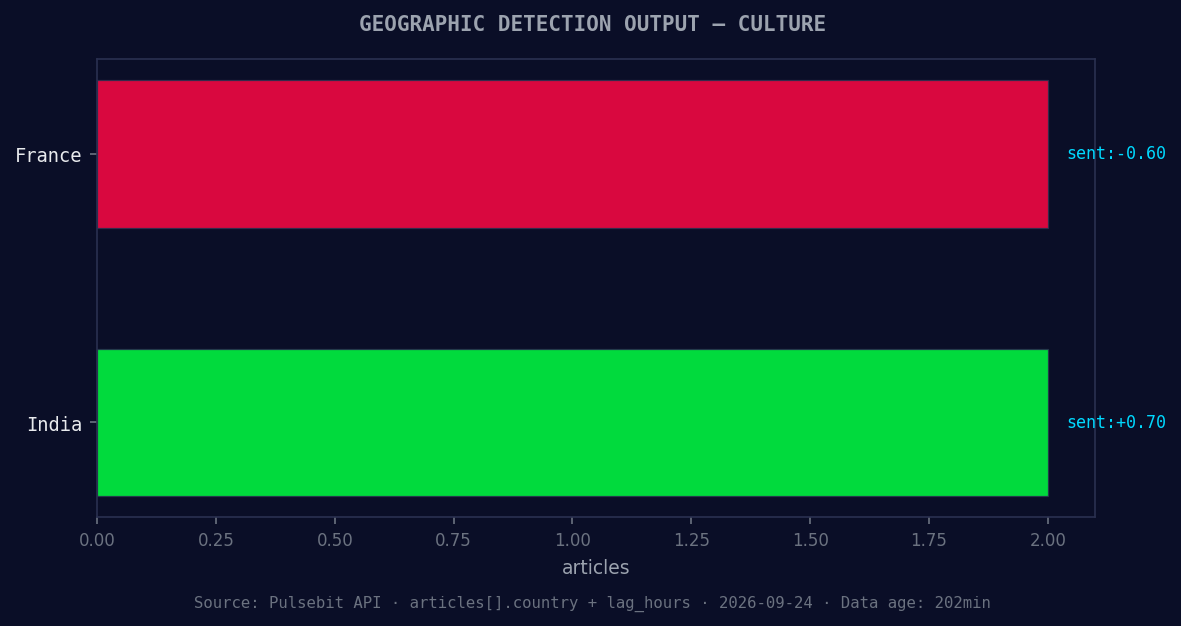
*Geographic detection output for culture. France leads with 2 articles and sentiment -0.60. Source: Pulsebit /news_recent geographic fields.*
data = response.json()
# Meta-sentiment moment
cluster_reason = "Clustered by shared themes: local, festivals, promotes, ithaca’s, celebrating."
sentiment_response = requests.post(
'https://api.pulsebit.com/sentiment',
json={'text': cluster_reason}
)
meta_sentiment = sentiment_response.json()
In this code, we first pull sentiment data filtered by the English language, ensuring that we're looking at the most relevant articles. Then, we loop back the narrative framing through our API to score the sentiment of the reasons behind the cluster. This dual approach not only gives us the momentum score but also allows us to analyze the context within which these sentiments are formed.
Now, let’s build on this interesting pattern. Here are three specific things we can create using this data:
Cultural Event Alert: Implement a threshold alert when the sentiment momentum for topics like culture exceeds +0.25. Utilize the geo filter to ensure you’re capturing relevant localized sentiments. This will help you stay ahead of cultural waves in specific regions.
Sentiment Narrative Analysis: Build an endpoint that continuously monitors narratives around clustered themes. For example, if the cluster reason shows a significant positive shift, like +0.180 for Monde, trigger an analysis of articles that contribute to this sentiment. This insights loop could be invaluable for PR strategies.
Trending Themes Dashboard: Create a dashboard that visualizes forming themes (like culture and local festivals) and compares their sentiment scores against mainstream narratives. For instance, track metrics like local, festivals, and promotes, and flag any discrepancies that arise when sentiment diverges from mainstream narratives.
By leveraging these signals and insights, we can ensure that our models remain agile and responsive to real-world cultural dynamics.
If you’re eager to dive into this, check out our documentation at pulsebit.lojenterprise.com/docs. You can copy-paste and run this in under 10 minutes, giving you the edge you need to catch those cultural sentiment leads before they become mainstream.


Top comments (0)