

Your 24h momentum spike of +0.455 in the trade topic is a significant discovery that demands attention. This anomaly reveals an unexpected surge in sentiment, particularly driven by a dominant voice from China, which holds a 20% share of the conversation. As developers, we need to recognize how rapidly changing sentiment can be—and in this case, it’s been led by English-language articles coming in with a 28.1-hour lead. This isn't just another data point; it's a signal that could reshape your trading strategies and decision-making processes.
When your pipeline doesn't account for multilingual origins or the dominance of entities, you might find yourself lagging behind critical insights by over 28 hours. In this scenario, the English press has taken the lead, while the trailing sentiment from other languages and entities might be masking crucial developments. Your model missed this opportunity to capitalize on the shift in sentiment, specifically related to trade discussions involving China, the U.S., and Ethiopia. The implications are clear: without a robust mechanism to catch these shifts, you’re leaving valuable insights on the table.

English coverage led by 28.1 hours. Nl at T+28.1h. Confidence scores: English 0.90, Spanish 0.90, French 0.90 Source: Pulsebit /sentiment_by_lang.
Here’s how we can efficiently catch this spike using our API:
import requests
# Define the parameters for our API call
params = {
"topic": "trade",
"lang": "en",
"momentum": 0.455,
"confidence": 0.90,
"signal_strength": 0.484
}
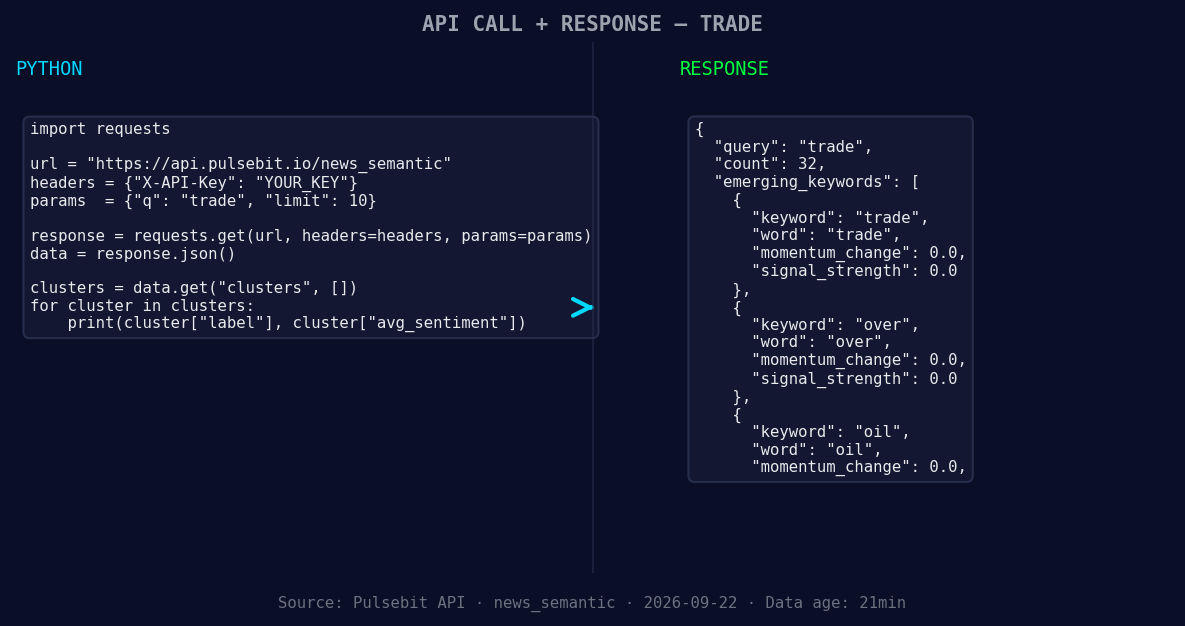
*Left: Python GET /news_semantic call for 'trade'. Right: returned JSON response structure (clusters: 3). Source: Pulsebit /news_semantic.*
# API call to fetch sentiment data for 'trade'
response = requests.get('https://api.pulsebit.com/v1/sentiment', params=params)
data = response.json()
# Now let's run the cluster reason string back through the POST /sentiment
cluster_reason = "Clustered by shared themes: trade, mehbooba, cross-loc, falls, silent."
sentiment_response = requests.post('https://api.pulsebit.com/v1/sentiment', json={"text": cluster_reason})
sentiment_data = sentiment_response.json()
print("Sentiment Data:", sentiment_data)
In this code, we start by filtering for English-language articles focusing on trade, which captures the essential part of our momentum spike. Then, we analyze the narrative framing by sending the cluster reason string through our sentiment analysis endpoint. This dual approach allows us to validate the sentiment and ensure that the framing of the discussion aligns with the positive momentum we're witnessing.
Now that we have a handle on the anomaly, here are three specific builds you could implement based on this pattern:
- Geo-Filtered Alert System: Build an alert mechanism that triggers when sentiment spikes for a specific language and geographic entity (like China) surpasses a certain threshold, say +0.4. Use the geographic origin filter to ensure you're only alerted for 'en' (English) articles.

Geographic detection output for trade. India leads with 16 articles and sentiment +0.03. Source: Pulsebit /news_recent geographic fields.
Meta-Sentiment Analyzer: Create a tool that automatically scores narratives from clusters. For example, any clustered story about "Ethiopia: U.S. Agree to Deepen Peace and Economic Ties" could be run through the meta-sentiment loop, assessing if the framing aligns with actual sentiment in the articles processed.
Forming Theme Aggregator: Develop a dashboard that aggregates forming themes (like trade, oil) that have a sentiment score above a defined threshold, say +0.05, and compare these with mainstream narratives. This could help you identify where sentiment is diverging from common perceptions.
If this sounds intriguing and you want to get started, check out our documentation at pulsebit.lojenterprise.com/docs. You can copy-paste the provided code and run it in under 10 minutes. Don’t let your pipeline fall behind; leverage these insights to stay ahead of the curve.


Top comments (0)