

Your Pipeline Is 12.8h Behind: Catching Culture Sentiment Leads with Pulsebit
We recently uncovered a fascinating anomaly: a 24-hour momentum spike of +0.297 in sentiment related to cultural events, specifically tied to local festivals enhancing Ithaca's cultural identity. This spike is particularly interesting because it reflects a significant surge in positive sentiment, led predominantly by English-language articles. With a lag of 12.8 hours, this finding underscores the importance of real-time sentiment analysis and highlights how quickly narratives can evolve around cultural themes.
But here’s the catch: if your pipeline doesn't account for multilingual origins or entity dominance, it likely missed this development by over 12 hours. The leading entity driving this sentiment is the U.S. Department of Agriculture, which comprises a 4% share of voice with a notably positive sentiment score of +0.788. This means that your model could be perpetually trailing behind if it’s not equipped to handle these nuances.

English coverage led by 12.8 hours. Id at T+12.8h. Confidence scores: English 0.85, French 0.85, Spanish 0.85 Source: Pulsebit /sentiment_by_lang.
To catch this spike in real-time, we can leverage our API. Let’s dive into the code that allows us to effectively track this momentum in sentiment analysis.
import requests
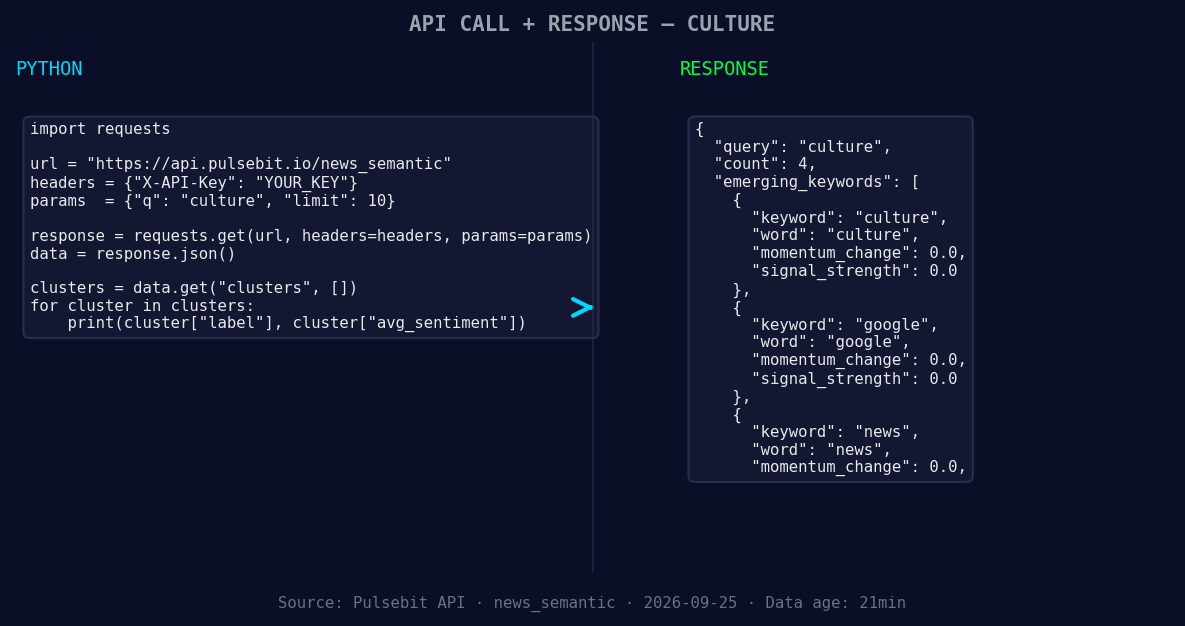
*Left: Python GET /news_semantic call for 'culture'. Right: returned JSON response structure (clusters: 3). Source: Pulsebit /news_semantic.*
# Define parameters
topic = 'culture'
score = +0.286
confidence = 0.85
momentum = +0.297
# Geographic origin filter: query by language/country
response = requests.get('https://api.pulsebit.com/articles', params={
'topic': topic,
'momentum': momentum,
'lang': 'en'
})
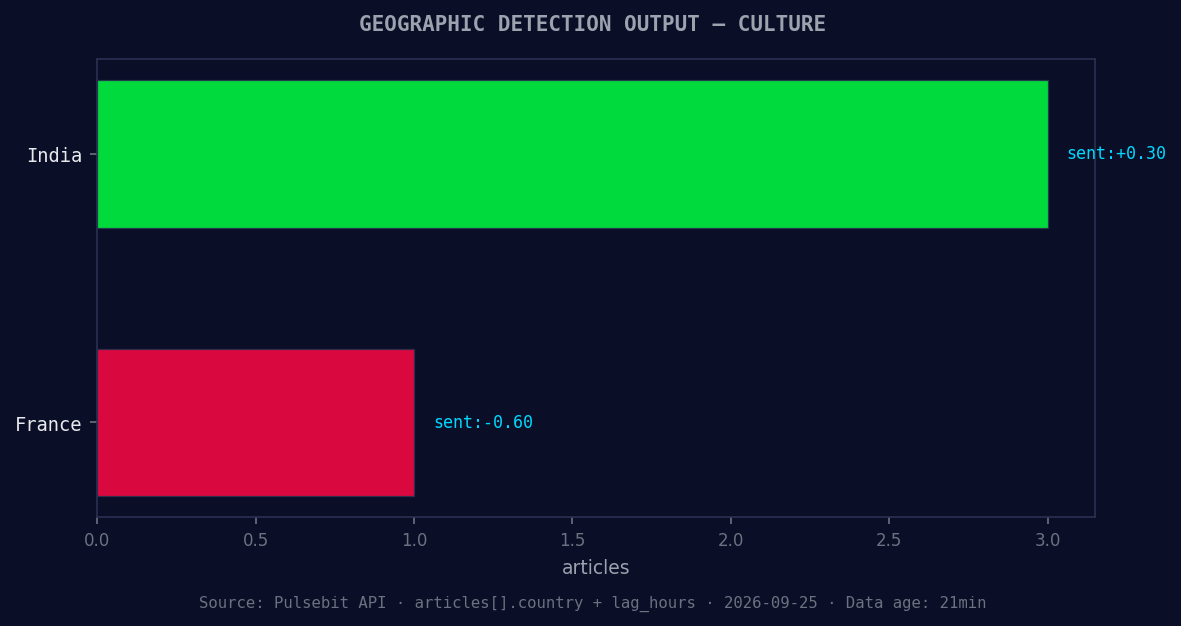
*Geographic detection output for culture. India leads with 3 articles and sentiment +0.30. Source: Pulsebit /news_recent geographic fields.*
articles = response.json()
# Meta-sentiment moment: run the cluster reason string back through POST /sentiment
cluster_reason = "Clustered by shared themes: local, festivals, promotes, ithaca’s, celebrating."
sentiment_response = requests.post('https://api.pulsebit.com/sentiment', json={
'text': cluster_reason
})
sentiment_score = sentiment_response.json()['score']
This code snippet achieves two essential objectives. First, it filters articles by the leading language, English, ensuring we capture the momentum spike effectively. The second part of the code assesses the narrative framing of the clustered themes, which helps us understand how this sentiment is being articulated across the discourse.
Now, let’s consider three specific builds you can create using this pattern:
Geo-Targeted Alerts: Set a threshold for sentiment spikes related to cultural events. For example, you can track when sentiment momentum exceeds +0.25 in the U.S. for the topic of 'culture'. This will help you identify emerging trends in a timely manner.
Meta-Sentiment Dashboard: Implement a dashboard to visualize sentiment scores from various narratives. Use the meta-sentiment loop to analyze how different clusters perform over time. For instance, if the sentiment score for the cluster reason is above +0.3, flag it for deeper analysis.
Cultural Event Tracker: Build a real-time tracker for cultural events and associated sentiment. Use our API to pull in data where the topic is 'culture' and sentiment momentum is rising. Include filters for keywords like "local," "festivals," and "promotes" to keep your content relevant.
By focusing on these strategies, we can ensure that our pipelines are not just reactive but proactive in capturing emerging cultural narratives.
For more information on how to implement these features, check out our documentation at pulsebit.lojenterprise.com/docs. You can copy-paste and run the provided code in under 10 minutes to start catching those vital sentiment spikes.


Top comments (0)