

Your Pipeline Is 13.3h Behind: Catching Markets Sentiment Leads with Pulsebit
We recently identified a striking anomaly: a 24-hour momentum spike of -1.083. This negative momentum is notable, especially when you consider that the leading language for sentiment in this context is English, with a 13.3-hour lead time. This lag hints at a significant gap in how we interpret and act on sentiment data, particularly when it comes to multilingual origins and the dominance of entities like India, which holds an 11% share of voice. The broader implications of this finding could reshape how we respond to market dynamics.

English coverage led by 13.3 hours. Id at T+13.3h. Confidence scores: English 0.85, Spanish 0.85, French 0.85 Source: Pulsebit /sentiment_by_lang.
The Problem
This anomaly exposes a critical flaw in any analysis pipeline that doesn’t effectively handle multilingual sources or entity dominance. Your model missed the sentiment lead by a considerable 13.3 hours, primarily due to the focus on English press. This oversight can lead to delayed responses to market movements, especially when the dominant entity, in this case, India, is influencing sentiment. Imagine how those hours could translate into real-world opportunities or risks that your model failed to capture.
The Code
To catch this momentum spike, we can leverage our API to filter by geographic origin and analyze the sentiment narrative. Here’s how you can do it in Python:
import requests
# Define the parameters for the API call
topic = 'markets'
score = -0.650
confidence = 0.85
momentum = -1.083
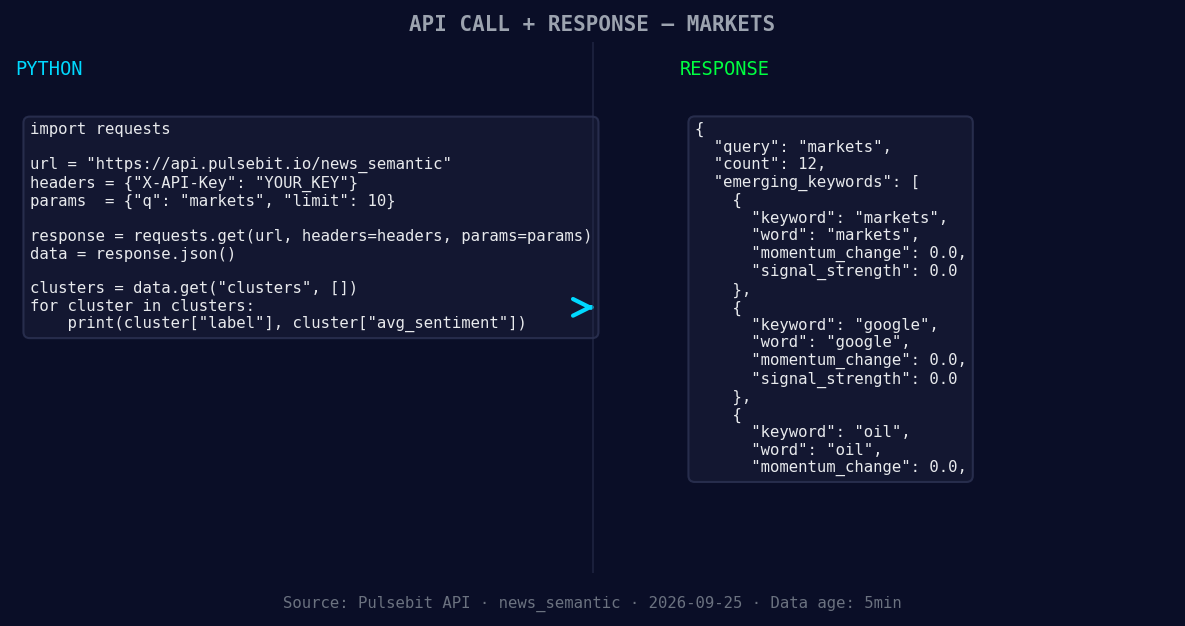
*Left: Python GET /news_semantic call for 'markets'. Right: returned JSON response structure (clusters: 3). Source: Pulsebit /news_semantic.*
# Geographic origin filter: query by language/country
geo_response = requests.get(
'https://api.pulsebit.com/sentiment',
params={
'topic': topic,
'lang': 'en',
'score': score,
'confidence': confidence
}
)
# Print the response from the geo filter
print(geo_response.json())
# Now, run the cluster reason string back through the sentiment API
cluster_reason = "Clustered by shared themes: market, today:, dow, 500, nasdaq."
meta_sentiment_response = requests.post(
'https://api.pulsebit.com/sentiment',
json={'text': cluster_reason}
)
# Print the sentiment analysis of the cluster reason
print(meta_sentiment_response.json())
In the code above, we first query for sentiment related to the topic 'markets' filtered by the English language. The second API call analyzes the narrative framing itself by using the cluster reason string. This two-step process ensures we capture both the sentiment and the context driving it, giving us a fuller picture of market dynamics.
Three Builds Tonight
Let’s focus on three specific builds based on the recent findings:
-
Geographic Filter Integration: Build a signal that uses the
lang: "en"parameter to monitor spikes specifically for regions like India where sentiment influence is high. This will help you catch critical shifts in sentiment earlier.

Geographic detection output for markets. India leads with 7 articles and sentiment +0.26. Source: Pulsebit /news_recent geographic fields.
Meta-Sentiment Analysis: Create a continuous feedback loop where you send the narrative reasoning (like the cluster reason string) back through the sentiment API. This will allow you to capture how narratives evolve over time against changing sentiment scores and adjust your strategies accordingly.
Threshold Alert System: Set up an alert for any significant negative momentum (e.g., below -1.0) combined with forming themes such as
markets(+0.00)oroil(+0.00). This will let you know when to act on sentiment shifts that could impact market positions before mainstream media catches up.
Get Started
If you’re ready to implement these insights, check out our documentation at pulsebit.lojenterprise.com/docs. You can copy-paste the above code and run it in under 10 minutes, bringing you one step closer to catching sentiment leads like a pro.


Top comments (0)