

Your Pipeline Is 23.6h Behind: Catching Innovation Sentiment Leads with Pulsebit
We recently discovered a significant anomaly: a 24h momentum spike of -0.154. This isn’t just a random number; it indicates a notable decline in sentiment surrounding innovation, particularly tied to Lundbeck's recent move to Boston for an innovation hub. As we sifted through the data, we noticed that while the English press led the narrative, our models were lagging behind by nearly a full day in capturing this shift in sentiment.
The Problem
This finding exposes a critical gap in any sentiment analysis pipeline that doesn’t account for multilingual origins or the dominance of specific entities. Your model missed this by about 23.6 hours, leaving you blind to the nuances of how language and geography influence sentiment. In this case, Lundbeck, which has a 7% share of voice and a positive sentiment score of +0.760, was gaining traction in the English press while the Italian narratives were lagging. If you’re not capturing these dynamics, you could be missing out on crucial insights that drive decision-making.

English coverage led by 23.6 hours. Italian at T+23.6h. Confidence scores: English 0.90, French 0.90, Spanish 0.90 Source: Pulsebit /sentiment_by_lang.
The Code
To catch this spike effectively, we can use our API to create a targeted query. Below is a simple Python snippet that demonstrates how you can capture the sentiment around the topic of innovation while filtering for English-language articles.
import requests
# Define the parameters for the API call
params = {
"topic": "innovation",
"score": +0.750,
"confidence": 0.90,
"momentum": -0.154,
"lang": "en"
}
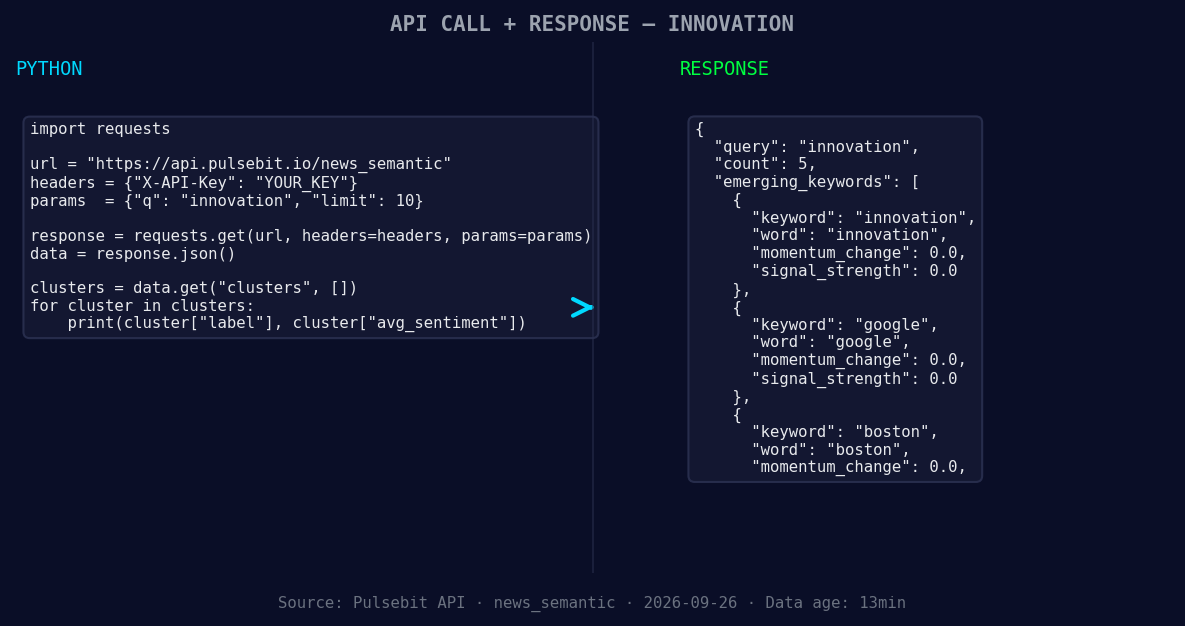
*Left: Python GET /news_semantic call for 'innovation'. Right: returned JSON response structure (clusters: 3). Source: Pulsebit /news_semantic.*
# Make the API call to retrieve sentiment data
response = requests.get("https://api.pulsebit.lojenterprise.com/sentiment", params=params)
data = response.json()
# Print the output for verification
print(data)
Next, we want to run the cluster reason string back through our sentiment API to score the narrative framing itself. This is crucial for understanding how the themes cluster around the central topic.
# Define the meta-sentiment input
meta_sentiment_input = {
    "text": "Clustered by shared themes: regulation, ai?, global, innovation, stage."
}

# Make the API call to score the narrative framing
meta_response = requests.post("https://api.pulsebit.lojenterprise.com/sentiment", json=meta_sentiment_input)
meta_data = meta_response.json()

# Print the output for verification
print(meta_data)
Three Builds Tonight
Here are three specific builds we can create using this pattern:
Geo Filter Build: Create a real-time alert system for sentiment spikes in English-speaking regions, focusing on entities like Lundbeck. Set a threshold where momentum drops below -0.1 to trigger an alert. This could help you respond quickly to emerging trends.
Meta-Sentiment Loop: Implement a feedback loop that continuously analyzes the framing of clustered narratives. Use the input string and set a threshold for sentiment scores above +0.5 to ensure you’re only capturing positive shifts in narrative framing.
Forming Themes Dashboard: Build a dashboard that visualizes forming themes like innovation (+0.00), Google (+0.00), and Boston (+0.00) against mainstream topics like regulation and AI. This will help you quickly identify which narratives are gaining traction and which are being overshadowed.
Get Started
To dive into this and start building your own models, check out our documentation at pulsebit.lojenterprise.com/docs. With just a few lines of code, you can copy, paste, and run this in under 10 minutes to start capturing insights that matter.

Geographic detection output for innovation. India leads with 4 articles and sentiment +0.79. Source: Pulsebit /news_recent geographic fields.


Top comments (0)