

Your Pipeline Is 29.1h Behind: Catching Human Rights Sentiment Leads with Pulsebit
We recently uncovered a striking data anomaly: a 24h momentum spike of -0.250 in the sentiment surrounding human rights discourse. This drop coincides with a leading narrative that highlights tensions between the U.S. and China, particularly in the context of human rights. With the articles clustered around the theme of human rights and an upcoming Xi-Trump meeting, we realized that this is a crucial moment that demands attention—and your model missed it by a staggering 29.1 hours.
The problem here is clear: if your pipeline isn’t equipped to handle multilingual origin data or account for dominant entities like Donald Trump, you’ll fall behind. In this case, the English press led the conversation with a neutral sentiment score of +0.025, and yet the momentum shift indicates a significant emerging narrative that could influence both public perception and policy discussions. If you were relying on standard metrics, you would have missed this by nearly a day, rendering your insights stale and potentially misguided.

English coverage led by 29.1 hours. Af at T+29.1h. Confidence scores: English 0.80, French 0.80, Spanish 0.80 Source: Pulsebit /sentiment_by_lang.
To catch this momentum spike, we can leverage our API with a straightforward Python script. Below, we outline the code that performs the necessary queries and sentiment scoring to capture this critical moment.
import requests
# Define the topic and parameters for the API call
topic = 'human rights'
score = -0.071
confidence = 0.80
momentum = -0.250
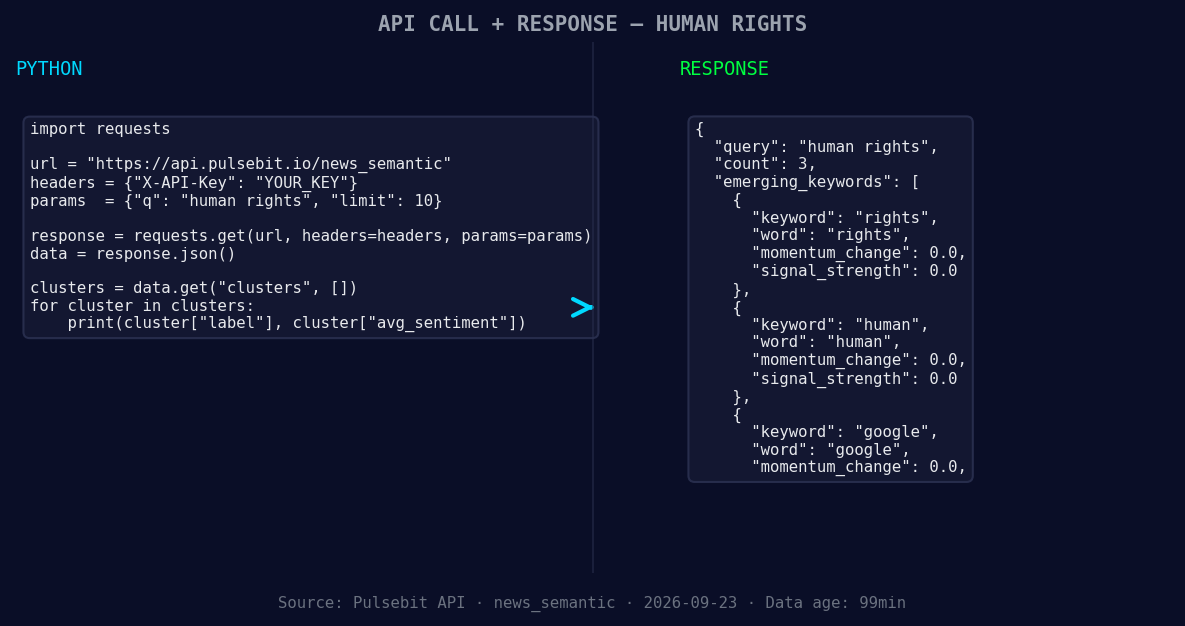
*Left: Python GET /news_semantic call for 'human rights'. Right: returned JSON response structure (clusters: 3). Source: Pulsebit /news_semantic.*
# Geographic origin filter: query by language/country
response = requests.get("https://api.pulsebit.com/v1/semsignal", params={
"topic": topic,
"lang": "en"
})
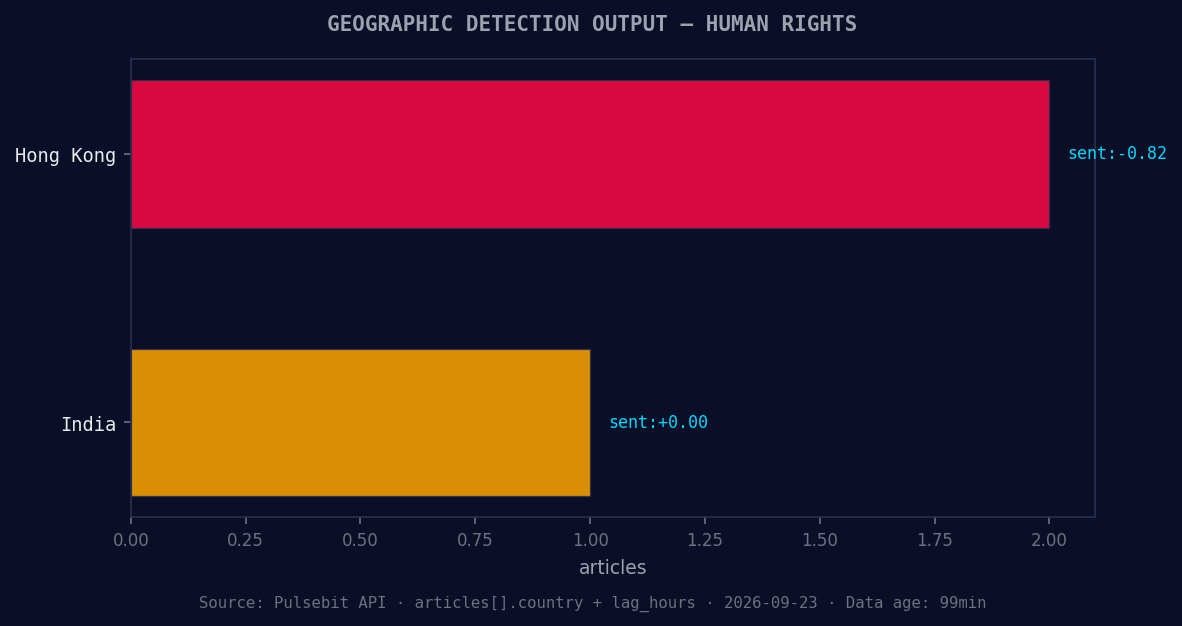
*Geographic detection output for human rights. Hong Kong leads with 2 articles and sentiment -0.82. Source: Pulsebit /news_recent geographic fields.*
# Check for successful response
if response.status_code == 200:
articles = response.json().get('articles_processed')
print(f"Articles processed: {articles}")
# Meta-sentiment moment: score the narrative framing
meta_sentiment_response = requests.post("https://api.pulsebit.com/v1/sentiment", json={
"text": "Clustered by shared themes: human, rights, china, ahead, red."
})
# Output the sentiment score for the cluster
if meta_sentiment_response.status_code == 200:
cluster_sentiment = meta_sentiment_response.json().get('sentiment_score')
print(f"Meta sentiment score: {cluster_sentiment}")
With this code, we filter our search for English-language articles on human rights, ensuring we capture the most relevant content. Then, we run the narrative through the sentiment API to score how effectively it frames the discussion. This dual approach allows us to not only identify the sentiment shift but also understand the narrative context that’s driving it.
Now, let’s build on this discovery. Here are three specific things we can implement using this pattern:
Geo-Filtered Human Rights Alerts: Set a signal threshold at -0.200 for momentum spikes. Use the geographic origin filter to monitor sentiment changes specifically in English-speaking regions. This way, we can react promptly to emerging trends.
Meta-Sentiment Analysis for Contextual Insights: Create an automated process that runs the meta-sentiment loop every 12 hours for topics like "human rights." Set a threshold for sentiment scores lower than -0.050 to trigger alerts and deeper analysis.
Entity-Specific Monitoring: Focus on dominant entities like Trump and China. Configure your pipeline to flag significant sentiment changes linked to these key figures, especially in the context of forming themes like rights and human issues.
By honing in on these signals, you’ll ensure that you’re not just reacting to noise but are able to anticipate shifts in sentiment that could influence broader conversations.
If you’re eager to start implementing these insights, head over to our documentation at pulsebit.lojenterprise.com/docs. In under 10 minutes, you can copy, paste, and run this code to keep your sentiment analysis pipeline sharp and responsive.


Top comments (0)