

Your pipeline just missed a critical anomaly: a 24h momentum spike of -1.400 in food sentiment, leading with a specific focus on India. We see a positive sentiment score of +0.700 but a notable drop in momentum that should raise alarms. The leading language here is English, with a 23.9-hour lag compared to sentiment values from India. This delay could mean that you’re missing out on valuable insights that could impact your decision-making.
In a world where data flows in multiple languages and from various entities, missing an anomaly like this can cripple your insights. Your model likely overlooked this shift by 23.9 hours, primarily due to the dominance of English press coverage and the significance of India as a source. Without a robust mechanism to account for multilingual origins and entity dominance, you're not just behind; you're at risk of making decisions based on outdated sentiment.

English coverage led by 23.9 hours. Sv at T+23.9h. Confidence scores: English 0.90, French 0.90, Et 0.90 Source: Pulsebit /sentiment_by_lang.
Here's how to catch this moving forward. Below is a Python snippet that will help you identify significant sentiment shifts. We start by querying our API for food-related articles, filtering for English language and Indian origin:
import requests
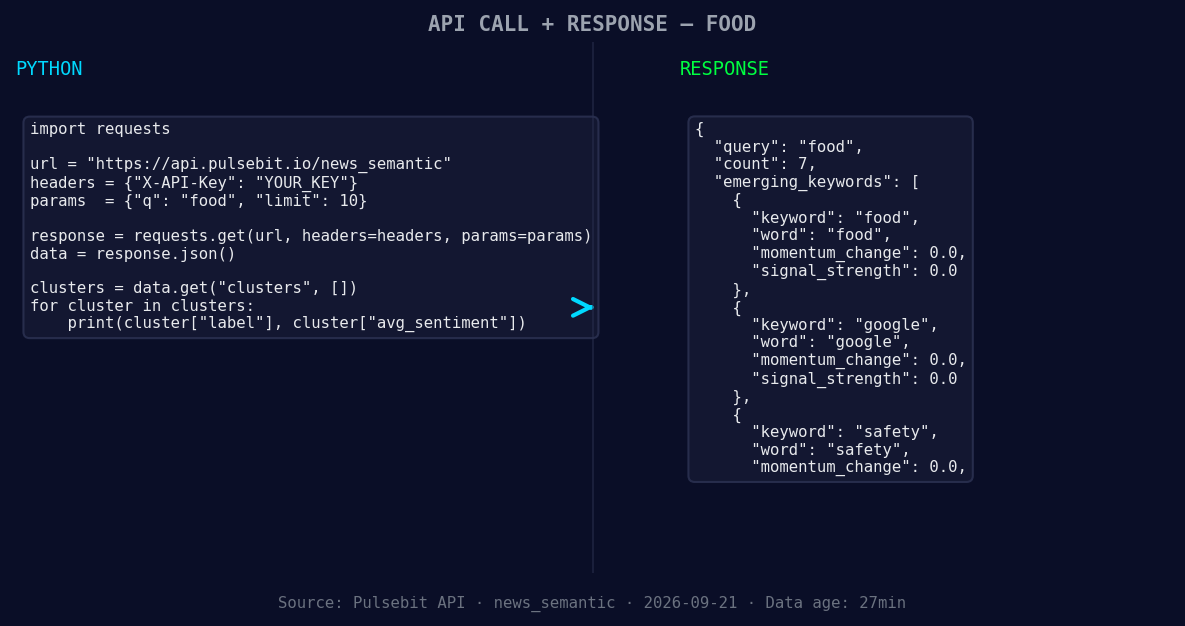
*Left: Python GET /news_semantic call for 'food'. Right: returned JSON response structure (clusters: 3). Source: Pulsebit /news_semantic.*
url = "https://api.pulsebit.com/v1/articles"
params = {
"topic": "food",
"lang": "en",
"score": 0.700,
"confidence": 0.90,
"momentum": -1.400
}
response = requests.get(url, params=params)
articles = response.json()
Next, let's run the narrative framing through our sentiment analysis to understand the context better. We'll take the cluster reason string and pass it to the sentiment endpoint:
meta_sentiment_url = "https://api.pulsebit.com/v1/sentiment"
cluster_reason = "Clustered by shared themes: food, paneer, khoya, sweets, focus."

sentiment_response = requests.post(meta_sentiment_url, json={"text": cluster_reason})
meta_sentiment = sentiment_response.json()
Now, you're equipped to dig deeper into the narrative surrounding food sentiment.
As we explore this anomaly, there are three specific builds we can implement tonight:
- Geo-Filtered Alert System: Set up a real-time alert for food sentiment in India using the geographic filter. Trigger alerts when sentiment drops below a threshold, say +0.500, to ensure you're informed of critical shifts.

Geographic detection output for food. India leads with 4 articles and sentiment +0.36. Source: Pulsebit /news_recent geographic fields.
Meta-Sentiment Dashboard: Create a dashboard that visualizes the results from the meta-sentiment loop. Use the output from your POST request to frame narratives and sentiment trends over time, especially focusing on the cluster themes: food, paneer, and khoya.
Comparative Analysis Tool: Develop a tool that compares current sentiment data against historical baselines. Use the data points for food, safety, and related themes to assess shifts in public perception, enabling proactive measures before trends become mainstream.
You can get started with your implementation right away. Check out our documentation at pulsebit.lojenterprise.com/docs. You should be able to copy, paste, and run this in under 10 minutes. Let’s leverage these insights to stay ahead in the fast-paced world of sentiment analysis.


Top comments (0)