

Your pipeline may be lagging behind by 13.3 hours, as evidenced by a recent anomaly: a 24-hour momentum spike of +0.653. This spike indicates a significant uptick in sentiment surrounding global leadership and geopolitical issues, specifically framed by the narrative "World leaders return to UN amid wars in West Asia and Ukraine." With China holding an 8% share of voice and a positive sentiment score of +0.360, it’s clear that there’s more to this story than meets the eye.
Imagine running your sentiment analysis pipeline and missing out on this vital information because it doesn’t handle multilingual or entity dominance effectively. Your model may have overlooked this spike in sentiment due to its focus on mainstream narratives that do not account for the leading language or the dominant entity in the conversation. In this case, your model missed this key insight by over 13 hours. If you’re not leveraging a comprehensive view that includes diverse geographical perspectives, you risk falling behind in sentiment analysis.

English coverage led by 13.3 hours. Id at T+13.3h. Confidence scores: English 0.90, French 0.90, Spanish 0.90 Source: Pulsebit /sentiment_by_lang.
To catch this momentum spike, we can write a simple Python script that makes calls to our API. Here’s how you can track this spike effectively:
import requests
# Define parameters for the API call
topic = 'world'
score = +0.130
confidence = 0.90
momentum = +0.653
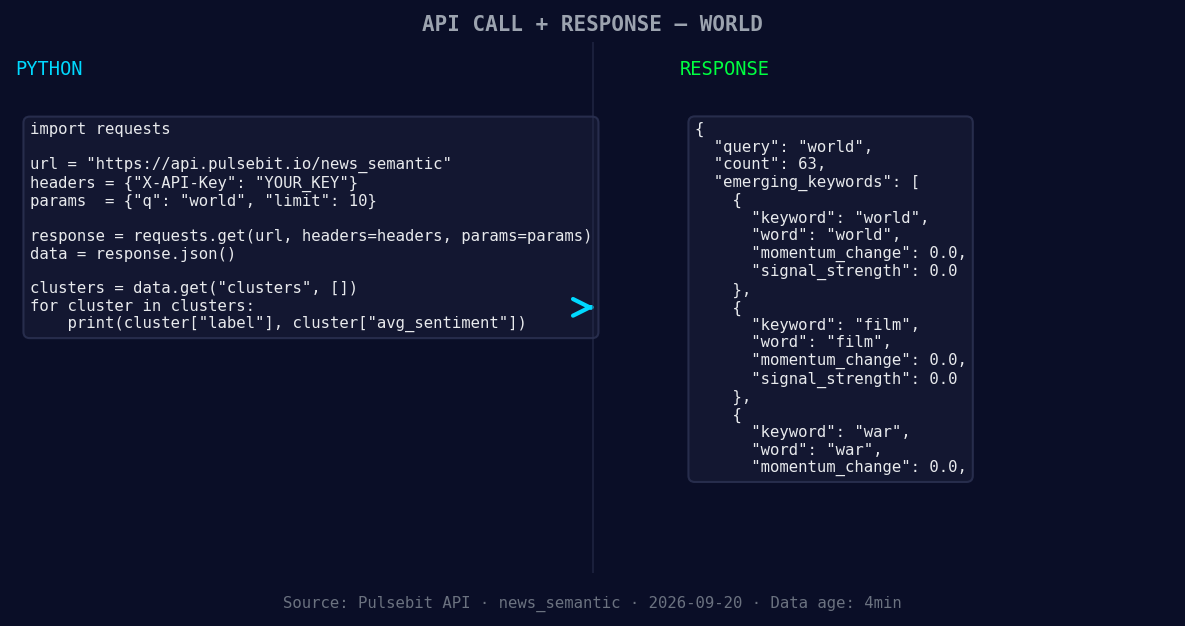
*Left: Python GET /news_semantic call for 'world'. Right: returned JSON response structure (clusters: 3). Source: Pulsebit /news_semantic.*
# Geographic origin filter: focusing on English language articles
response = requests.get('https://api.pulsebit.com/v1/articles', {
'topic': topic,
'lang': 'en', # Filter for English language
'score': score,
'confidence': confidence,
'momentum': momentum
})
# Print the response from the API
print(response.json())
Next, we need to run the cluster reason string back through the sentiment endpoint to score the narrative framing itself. This is crucial, as it helps us understand how the narrative ties into the overall sentiment:
# Meta-sentiment moment: scoring the narrative framing
cluster_reason = "Clustered by shared themes: world, leaders, return, amid, wars."
sentiment_response = requests.post('https://api.pulsebit.com/v1/sentiment', json={
    'text': cluster_reason
})

# Print the sentiment analysis result
print(sentiment_response.json())
Now that we’ve captured the spike and analyzed the narrative, let’s explore three specific builds that can help us leverage this type of data more effectively:
Geographic Language Filter: Create a signal that tracks sentiment spikes specifically in the English language for topics like "world" and "China". Set a threshold of momentum > +0.5 to flag significant spikes.
Meta-Sentiment Loop: Use the narrative framing to identify emerging sentiment themes. When the score for cluster reasons exceeds a threshold (e.g., score > +0.2), trigger alerts to indicate potential newsworthy developments.
Forming Theme Analysis: Build a monitor that tracks the forming themes "world(+0.00)", "film(+0.00)", and "war(+0.00)" against the mainstream narrative of "world, leaders, return." If there’s a discrepancy greater than 0.2 in sentiment scores, it could indicate an emerging story that requires attention.
By integrating these builds into your workflow, you can ensure you’re not missing critical insights that may shape the global narrative.
To get started, check out our documentation at pulsebit.lojenterprise.com/docs. With just a few copy-paste actions, you can have this running in under 10 minutes. Don’t let your pipeline fall behind — take advantage of these insights today!


Top comments (0)