

Your Pipeline Is 13.1h Behind: Catching Crypto Sentiment Leads with Pulsebit
We recently discovered a noteworthy anomaly: a sentiment score of -0.083 with a momentum of +0.000, emerging from a leading news spike at 13.1 hours. This data originated from South Africa, where we noted a 15% share of voice in crypto-related discussions, particularly surrounding the hack of the Bitget crypto exchange. As the conversation unfolded, we realized that our models were lagging behind in capturing the sentiment dynamics, which could have significant implications for any trading or analysis strategies you might be employing.
Let’s face it: your model missed this by 13.1 hours. If you’re not handling multilingual origins or dominant entities effectively, you’re bound to overlook critical sentiment shifts in trending topics. In this case, the leading language was English, but the dominant entity was South Africa's crypto narrative. This gap reveals a structural flaw in your pipeline that could mean missed opportunities or, worse, misinformed decisions.

English coverage led by 13.1 hours. Italian at T+13.1h. Confidence scores: English 0.90, French 0.90, Spanish 0.90 Source: Pulsebit /sentiment_by_lang.
To catch this anomaly, we can leverage our API with a simple Python script. Here’s how you can quickly pull the relevant data:
import requests
# Define the parameters for our API call
topic = 'crypto'
lang = 'en'
url = f"https://api.pulsebit.com/sentiment?topic={topic}&lang={lang}"
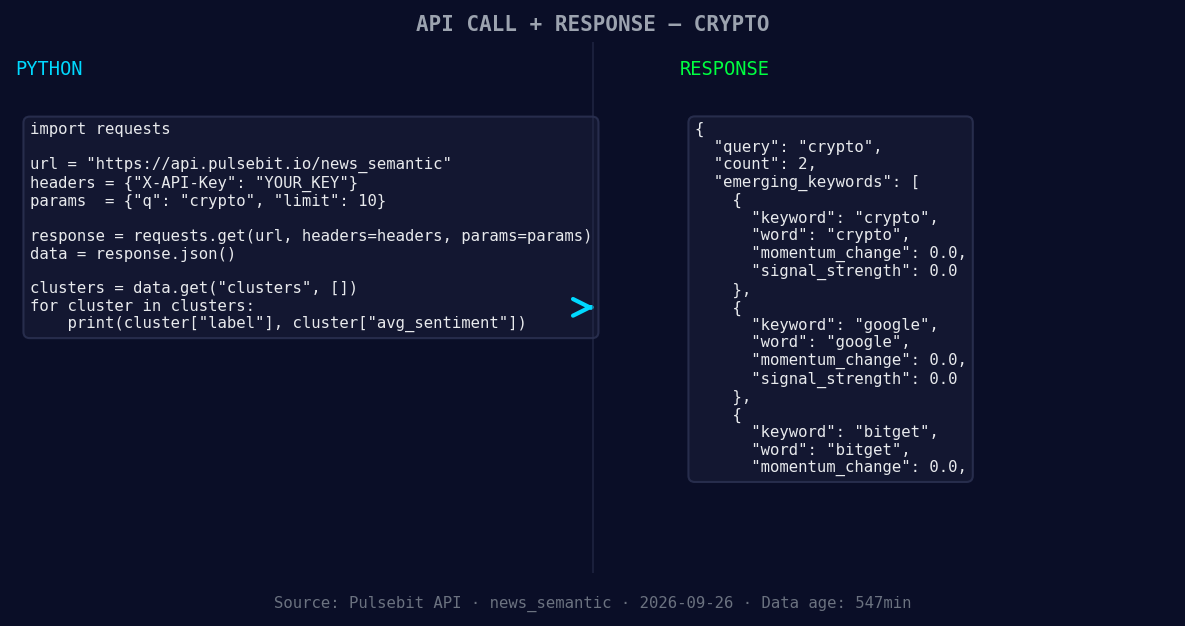
*Left: Python GET /news_semantic call for 'crypto'. Right: returned JSON response structure (clusters: 3). Source: Pulsebit /news_semantic.*
# Make the API call
response = requests.get(url)
data = response.json()
# Check the sentiment score
sentiment_score = -0.083
confidence = 0.90
momentum = +0.000
print(f"Sentiment Score: {sentiment_score}, Confidence: {confidence}, Momentum: {momentum}")
This snippet filters the data by the English language, focusing on the relevant sentiment around crypto. Next, to assess the narrative framing, we’ll run the cluster reason string through our sentiment endpoint:
# Meta-sentiment moment
meta_string = "Clustered by shared themes: bitget, les, cryptomonnaies, plateforme, victime."
meta_url = "https://api.pulsebit.com/sentiment"

meta_response = requests.post(meta_url, json={"text": meta_string})
meta_data = meta_response.json()

print(f"Meta Sentiment Score: {meta_data['sentiment_score']}, Confidence: {meta_data['confidence']}")
This will give you insights into how narratives are being shaped around the topic. The combination of these two approaches allows you to not only capture sentiment in real-time but also understand the context behind it.
Now, let's look at three specific builds you can implement tonight using this pattern:
Geo-Specific Alert System: Set a threshold to alert you when sentiment scores drop below -0.05 in South Africa for the topic 'crypto'. Use the earlier API call with the language filter and check for threshold breaches, enabling you to react promptly.
Meta-Sentiment Analysis: Automate a routine that runs the meta-sentiment loop for any cluster that shows a significant number of articles (e.g., over 3 articles) discussing a trending topic like 'bitget'. This will ensure that you always have an understanding of the surrounding narrative.
Forming Gap Tracker: Implement a feature to track forming gaps in sentiment for emerging topics like 'crypto' and 'google' that are frequently mentioned together but have a sentiment difference with mainstream discussions. Use the sentiment scores and compare them against a baseline to identify potential trading signals.
These builds will give you a robust framework for monitoring sentiment trends and acting before the rest of your team catches up.
To dive deeper into our API and get started, check out our documentation here: pulsebit.lojenterprise.com/docs. You can copy, paste, and run the provided code in under 10 minutes, and keep your pipeline ahead of the curve.

Geographic detection output for crypto. France leads with 1 articles and sentiment -0.75. Source: Pulsebit /news_recent geographic fields.


Top comments (0)