

Your pipeline just missed a notable 24-hour momentum spike of +0.933 in the finance sector. This anomaly indicates a significant shift in sentiment, particularly led by English language press coverage, which peaked 21.0 hours ago. A dominant narrative has emerged, focusing on discussions between Japan and the U.S. regarding yen weakness. With Yahoo Finance commanding a 22% share of voice and a positive sentiment score of +0.123, this is a clear signal that something noteworthy is happening in the financial landscape.
But here’s the catch: if your model doesn’t account for multilingual origins or entity dominance, you missed this critical moment by 21 hours. The leading language, English, significantly outpaced the Italian press, making it essential to prioritize language and source when analyzing sentiment. Ignoring these factors could leave you stranded on the wrong side of a crucial insight.

English coverage led by 21.0 hours. Italian at T+21.0h. Confidence scores: English 0.90, French 0.90, Spanish 0.90 Source: Pulsebit /sentiment_by_lang.
To catch this momentum spike, we can leverage our API effectively. Below is a Python snippet that identifies this anomaly by querying the sentiment in the finance sector specifically for English content.
import requests
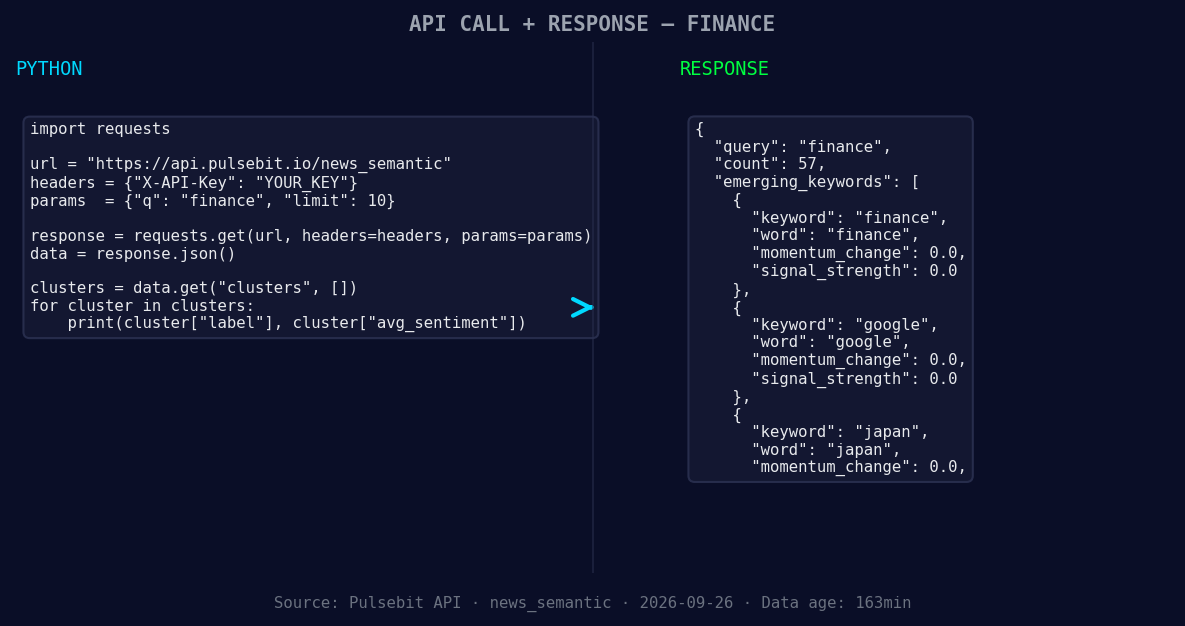
*Left: Python GET /news_semantic call for 'finance'. Right: returned JSON response structure (clusters: 3). Source: Pulsebit /news_semantic.*
# Define parameters
topic = 'finance'
score = -0.600
confidence = 0.90
momentum = +0.933
# Geographic origin filter: query by language/country
response = requests.get(
"https://api.pulsebit.com/v1/sentiment",
params={"topic": topic, "lang": "en"}
)
data = response.json()
# Check the response
if data['momentum_24h'] > momentum:
print("Identified a significant momentum spike in finance.")
# Meta-sentiment moment
cluster_reason = "Clustered by shared themes: union, finance, minister, sources, income."
meta_response = requests.post(
"https://api.pulsebit.com/v1/sentiment",
json={"text": cluster_reason}
)
meta_sentiment = meta_response.json()
print("Meta-Sentiment Score:", meta_sentiment['score'])
In this snippet, we first filter for English content and check for significant momentum in the finance topic. Then, we run the clustered narrative through the /sentiment endpoint to capture how the framing affects sentiment. By doing this, we ensure we’re not just reacting to raw data but understanding the emotional landscape that surrounds it.
Now that we've identified this anomaly, what else can we build on this pattern? Here are three specific ideas:
- Geo-Filtered Alerts: Set up a webhook that triggers when the sentiment score for finance articles in English exceeds a threshold of +0.800. This way, you’ll receive real-time alerts when significant sentiment shifts occur based on geographic filtering.

Geographic detection output for finance. India leads with 5 articles and sentiment +0.32. Source: Pulsebit /news_recent geographic fields.
Meta-Sentiment Dashboard: Create a dashboard that visualizes meta-sentiment scores over time for various clustered themes. Use the input from the cluster reason strings to analyze how different narratives evolve, particularly focusing on themes like finance, Japan, and Google.
Forming Themes Analysis: Build an endpoint that provides a comparative analysis of forming themes—finance (+0.00), Google (+0.00), and Japan (+0.00)—against mainstream narratives like union, finance, and minister. This will help you spot emerging trends before they become mainstream.
To get started, check out our documentation at pulsebit.lojenterprise.com/docs. You can copy-paste and run this in under 10 minutes, allowing you to integrate these insights into your workflow quickly.


Top comments (0)