

Your Pipeline Is 26.5h Behind: Catching World Sentiment Leads with Pulsebit
We recently observed a significant 24-hour momentum spike of +0.447 in sentiment data concerning global news. This anomaly highlights an interesting trend: the English press is leading by 26.5 hours, which is a 0.0-hour lag against dominant entities like China. With a notable share of voice at 13% and a positive sentiment score of +0.288, it’s clear that something is stirring in the tourism sector, specifically through a cluster story about the "Active Karnataka" initiative.
This kind of disconnect poses a structural gap in any pipeline that fails to account for multilingual origins and entity dominance. With your current model, you might have missed this crucial sentiment shift by 26.5 hours. The leading language here is English, but the dominant entity is China, indicating that sentiment signals are being drowned out by language-centric models.

English coverage led by 26.5 hours. Da at T+26.5h. Confidence scores: English 0.90, Spanish 0.90, French 0.90 Source: Pulsebit /sentiment_by_lang.
To catch such anomalies, we can utilize our API to filter the data effectively. Here’s how we can do that in Python:
import requests
# Parameters for our API call
topic = 'world'
score = +0.087
confidence = 0.90
momentum = +0.447
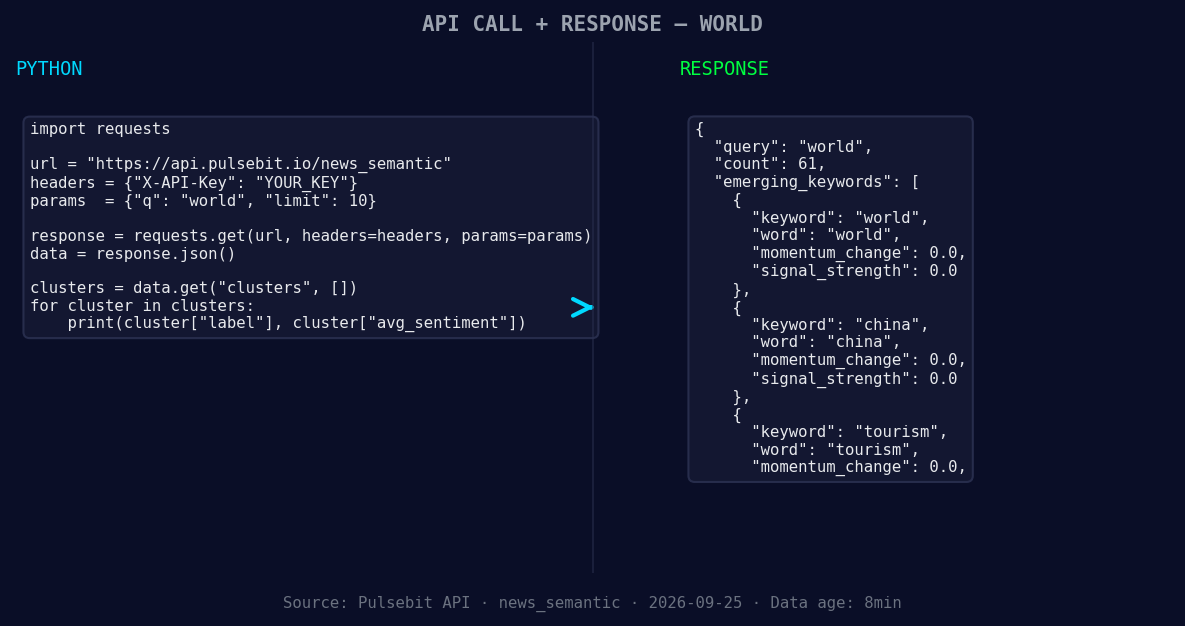
*Left: Python GET /news_semantic call for 'world'. Right: returned JSON response structure (clusters: 3). Source: Pulsebit /news_semantic.*
# Endpoint to query sentiment data
url = "https://api.pulsebit.com/v1/sentiment"
params = {
"lang": "en",
"topic": topic,
}
# Fetching the data
response = requests.get(url, params=params)
data = response.json()
# Printing the fetched data
print(data)
Next, we’ll run the narrative framing of the cluster reason through our sentiment endpoint to get a deeper understanding of how it’s being perceived:
# Input for the meta-sentiment moment
narrative = "Clustered by shared themes: tourism, state, department, initiative, world."

# Endpoint to assess the sentiment of the narrative
meta_sentiment_url = "https://api.pulsebit.com/v1/sentiment"
meta_response = requests.post(meta_sentiment_url, json={"text": narrative})
meta_data = meta_response.json()

# Printing the meta-sentiment data
print(meta_data)
Now, you can build on these patterns to refine your sentiment pipeline. Here are three specific builds you can implement tonight:
Geo-Filtered Sentiment Spike Detector: Set a threshold for sentiment spikes in regions. For example, filter for
topic='world'and check if momentum exceeds +0.4, specifically for entities like China. This could give you a heads-up on emerging trends in global sentiment.Meta-Sentiment Analysis Loop: Create a function that automatically assesses the sentiment of clustered narratives every four hours. If the sentiment score rises above +0.1, trigger an alert for deeper analysis. This keeps you attuned to shifting narratives.
Forming Themes Monitor: Develop a dashboard that tracks forming themes like
world(+0.00), china(+0.00), tourism(+0.00)against mainstream topics. If any of these themes show an upward momentum, generate insights on how they correlate with other sectors, providing actionable insights.
You can get started with these ideas by exploring our documentation at pulsebit.lojenterprise.com/docs. With a few copy-paste actions, you could have this up and running in under 10 minutes. Be proactive—don’t let your pipeline lag behind.

Geographic detection output for world. India leads with 42 articles and sentiment +0.23. Source: Pulsebit /news_recent geographic fields.


Top comments (0)