

Your 24h momentum spike is a striking +1.222, showcasing a significant shift in sentiment that you simply can't ignore. At the heart of this anomaly is a noteworthy focus on a specific cluster story: "Four-day heritage tour for Kalaburagi students to mark World Tourism Day." This narrative not only highlights local heritage but also demonstrates how stories can gain traction quickly when they resonate with cultural themes. In an age where information travels at lightning speed, this spike indicates a crucial moment in public sentiment — one that is ripe for capturing and analyzing.
What does this mean for your pipeline? If your setup doesn't account for multilingual origin or entity dominance, you're now stuck 10.6 hours behind. That’s a substantial lag time, especially when the leading language is English and the dominant entity is China, which holds a 10% share of voice in this context. Missing these vital signals means you're potentially overlooking critical shifts in public opinion — and that's a gap you can't afford.

English coverage led by 10.6 hours. Et at T+10.6h. Confidence scores: English 0.80, French 0.80, Spanish 0.80 Source: Pulsebit /sentiment_by_lang.
To catch this momentum shift, we can leverage our API to implement a targeted query. First, we’ll filter the data by geographic origin using the English language. Here’s how you can do it:

Geographic detection output for world. India leads with 31 articles and sentiment +0.17. Source: Pulsebit /news_recent geographic fields.
import requests
# Parameters for the API call
params = {
"topic": "world",
"score": +0.057,
"confidence": 0.80,
"momentum": +1.222,
"lang": "en" # Geographic origin filter
}
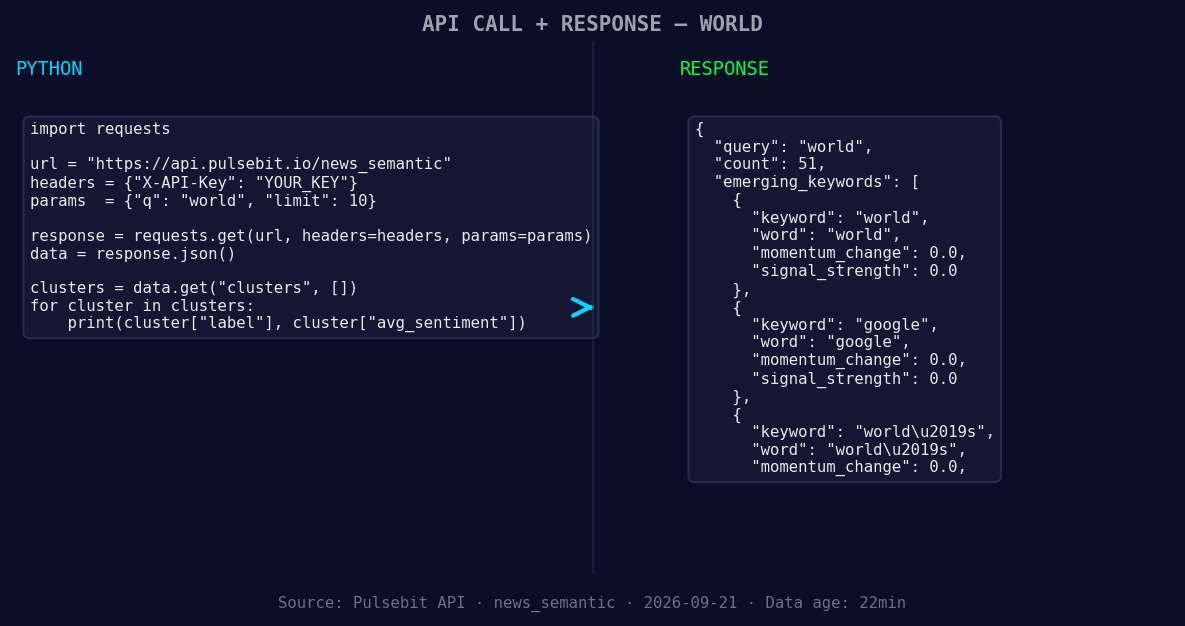
*Left: Python GET /news_semantic call for 'world'. Right: returned JSON response structure (clusters: 3). Source: Pulsebit /news_semantic.*
# API call to fetch sentiment data
response = requests.get("https://api.pulsebit.io/v1/sentiment", params=params)
data = response.json()
Now, to analyze the narrative framing itself, we will run the cluster reason string through our API to score it. The string we want to analyze is: "Clustered by shared themes: heritage, kalaburagi, four-day, tour, students." Here's how we can do that:
# Meta-sentiment moment
cluster_reason = "Clustered by shared themes: heritage, kalaburagi, four-day, tour, students."
meta_sentiment_response = requests.post("https://api.pulsebit.io/v1/sentiment", json={"text": cluster_reason})
meta_sentiment_data = meta_sentiment_response.json()
With the above two API calls, we can effectively capture the essence of what’s generating this spike in sentiment, allowing us to respond in real-time rather than playing catch-up.
Now, let’s explore three specific things we can build with this pattern:
Signal Monitoring: Set a threshold for momentum spikes at +1.222. Use the geo filter to monitor sentiment changes specifically in English-speaking regions. This allows you to capture localized trends as they happen.
Meta-Sentiment Analysis: Build a loop that processes the cluster reason strings for trending topics like "heritage," "kalaburagi," and "four-day" tours. This will help you frame narratives more effectively and understand the underlying sentiment around local events.
Forming Themes Notification: Create a notification system for forming themes such as "world" (+0.00), "google" (+0.00), and "world’s" (+0.00) versus mainstream topics like "heritage" and "kalaburagi." This can be integrated into your dashboard for real-time alerts.
By employing these strategies, you not only enhance your pipeline's responsiveness but also position yourself to capture critical sentiment shifts as they occur.
If you're ready to implement these insights, head over to our documentation at pulsebit.lojenterprise.com/docs. You can copy and paste the above code snippets and get this running in under 10 minutes. Happy coding!


Top comments (0)